

Why Your Lotion Turns White When You Rub It In (And How to Fix It)
INTRODUCTION
You know when you apply your lotion, and it turns white when you rub it in? Sometimes streaky, sometimes a bit draggy, sometimes a film that takes longer than it should to disappear into the skin. After a minute or so, it's gone, and the cream feels fine, but that white moment between application and absorption is one of the most common complaints in natural cream formulation, and one of the most misdiagnosed. While it is not exactly aesthetically pleasing, it is not a formula instability as such; consumer perception matters a lot, so we need to talk about it.
The formulator's term for these white streaks is soaping, or microfoam, and it has a clear technical cause within the emulsion system itself. The cause is not what most online resources point to, which is part of why the same fixes keep getting recommended without resolving the underlying problem.
THE MAIN CAUSE: AN IMBALANCE BETWEEN YOUR OILS AND EMULSIFIER
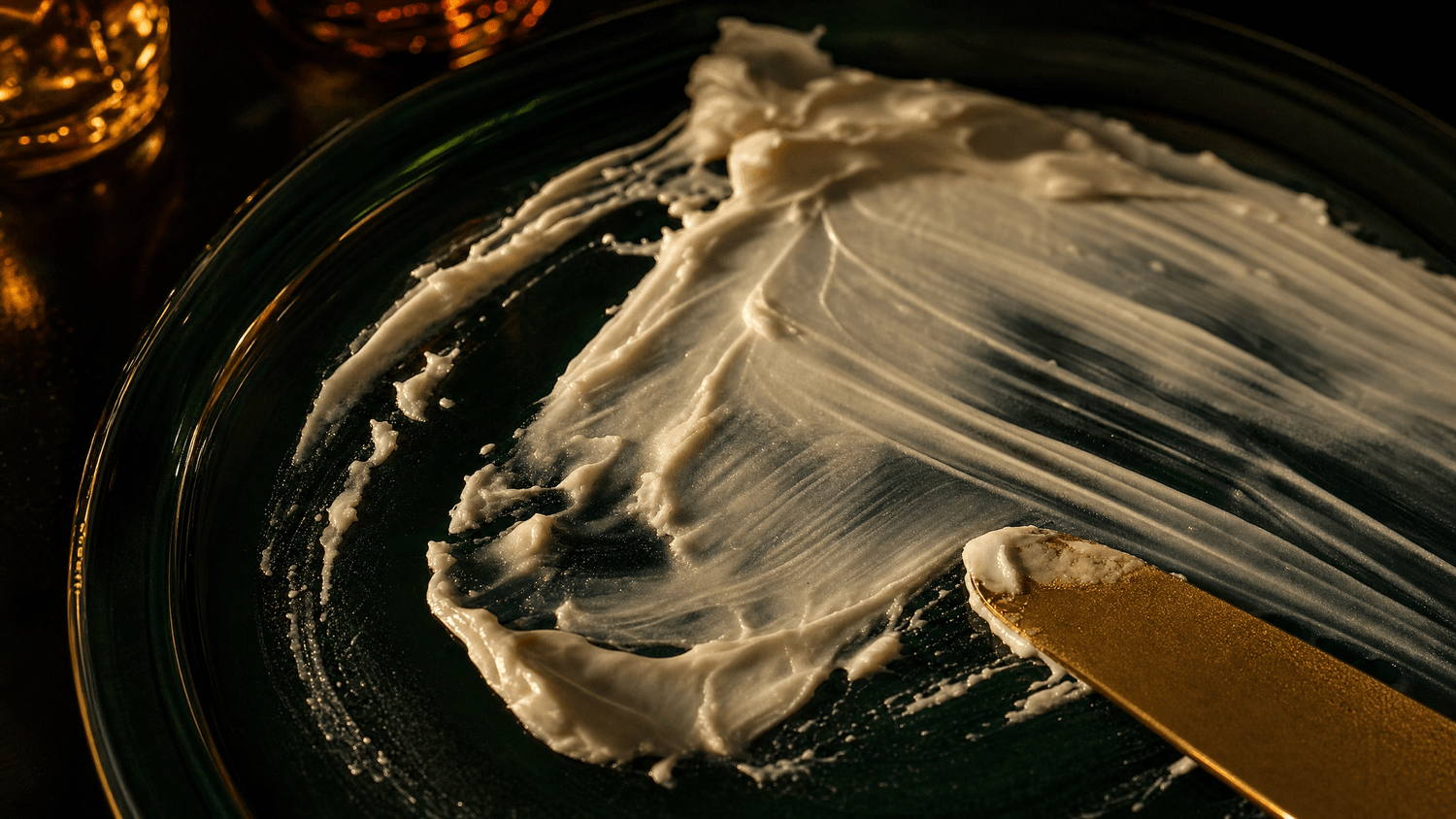
Most of the time, soaping comes down to an imbalance between the emulsifier and the oil phase. The emulsifiers we use in oil-in-water emulsions are high-HLB, and when we allocate more emulsifier than the oils actually need, you've got excess surface-active material with nothing useful to attach to. As you rub the cream into your skin, that excess catches air, and the trapped air bubbles are what you see as the white film.
The greater the imbalance, the more obvious the soaping. That's why this issue tends to show up most in formulas built for a thick, rich texture using a waxy emulsifier alone, and it's the part of the picture I'll come back to in a moment.
Other factors can add to the effect. A high level of gums or other structuring ingredients can make the film more visible, and aggressive mixing during cool-down can trap more air in the batch. In some formulas, the visual effect can be more noticeable if the system is especially structured, but the practical takeaway is the same: the problem usually gets worse when the formula is both highly structured and harder to spread.
Remember that emulsifiers are a type of surfactant. This means they have a water-loving head and an oil-loving tail. When an emulsion has more of that surfactant character than the oil phase can comfortably use, the system is more likely to foam, whiten, or streak during rub-in. In other words, the same ingredients that hold the lotion together can also make it temporarily appear white on the skin.
Quite often, natural lipids and lamellar emulsifiers such as Olivem 1000 get a bad rep because the white streaks tend to be more pronounced when these are used. But it doesn't mean you cannot eliminate the issue. In fact, I can tell you now that it is entirely possible to create a lovely emulsion with Olivem 1000 and natural lipids by paying attention to some details when putting your formula together.
WHY NATURAL CREAMS GET THIS MORE THAN SYNTHETIC ONES
Many natural-positioned emulsions deliberately exclude silicones. That means you lose the slip and rub-in refinement dimethicone can provide, so silicone-free formulas often need a different ingredient strategy to reduce white rub-in and keep the skin feel elegant.
That creates a practical balancing act. If you reduce the amount of primary emulsifier, you may ease soaping, but you may also lose the texture you wanted. If you increase the oil phase, that can help in some cases, but only until the formula starts to feel heavy or becomes harder to keep stable. That is why many formulators keep changing emulsifiers without fully solving the underlying issue.
The better fix is usually to rebalance the system rather than simply adding more of one ingredient or removing another. I’ll come back to that in the resolution section below.
HOW TO DIAGNOSE SOAPING IN YOUR SPECIFIC FORMULA
Three questions will tell you which mechanism is dominant in your formula.
Question one: Is your emulsifier load higher than your oil phase comfortably needs?
This is the question that explains most cases. If you pushed the emulsifier percentage up to build viscosity in the cream, that imbalance is often a major contributor to white rub-in.
Question two: How much gum is in your water phase?
A high gum content can amplify the visible film in some formulas, especially if the system is already highly structured. If your gum level is more than the formula really needs for stability and skin feel, bringing it down may help.
Question three: How aggressively did you mix during cool-down?
High-shear mixing during the cooling phase can trap air in the emulsion, and that air then has to come out during application. Switching to gentler stirring once the emulsion has formed can reduce that trapped air and improve rub-in.
In most natural cream soaping cases, question one is the best place to start. Questions two and three are contributing factors that can make the issue look worse than it otherwise would.
THE FIXES
The fixes below are the principles. The applied detail, such as which co-emulsifier to use, what percentage to start at, where the upper limits sit, and how to calculate the right balance for a specific oil phase, is the kind of formula-by-formula material that belongs in the Pro Formulator Path emulsion module and the FormuFix diagnostic flow.
Rebalance the system.
The most useful starting point is to look at the emulsifier-oil balance rather than just asking whether the lotion feels thick enough. If the emulsifier load is carrying too much of the structure, the fix is usually to rebalance the system rather than simply adding more emulsifier.
Check the water phase.
If your formula uses a lot of gum or other thickening agents, reduce them to the lowest level that still gives the stability and skin feel you want. The water phase is easy to overlook when the focus is on the oil phase, but it can have a big effect on rub-in.
Adjust the process.
Use higher shear only for emulsification, then switch to gentler stirring during cool-down. That helps reduce the amount of air trapped in the cream before it goes into the jar.
Use slip strategically, if your formulation style allows it.
A small amount of dimethicone or another fast-spreading emollient can improve rub-in and reduce visible whitening. For natural-positioned products, I strongly suggest adding esters and silicone replacements, such as Isoamyl Laurate, to your lipid phase.
WHAT SOAPING IS TELLING YOU
Soaping is a signal of the balance of your emulsion and how it behaves when rubbed into the skin. In most cases, it does not mean the formula has failed. A cream that shows mild whitening on application but is otherwise stable, well-preserved, and pleasant to use is still a functional product.
Where it matters is when the effect is visually severe, when it sits on the skin for too long, or when it appears alongside other signs that the emulsion is not quite right, such as drag, persistent streaking, or early separation. In those cases, the whitening is useful feedback because it points you toward a system that needs rebalancing.
There is also a customer-perception angle. People often read fast absorption as a sign that a product is working, and a persistent white film as a sign that it is not. That perception is not always technically fair, but it is commercially real. A product can be perfectly serviceable and still feel underwhelming if it sits white on the skin every time it is used.
WHAT TO DO NEXT
Work through the three diagnostic questions before changing anything in the formula. In most cases, the answer to question one will tell you where to start.
For the specific details applied, such as which co-emulsifier to add, what percentage to start at, how to calculate the balance for your oil phase, and where the upper limit sits before the system destabilises, FormuFix is built to walk you through that diagnosis for the formula you are actually holding.
The Pro Formulator Path programme covers the principle in depth as part of its emulsion module, including worked examples and a testing protocol.
If you want a deeper foundation in how emulsion systems work as a whole, the companion post this week covers what cosmetic emulsifiers do and why they rarely operate alone.
FormuFix

If you have a product that's separated, gone grainy, feels slimy, reacted unexpectedly, or simply doesn't feel right, this is the one.
FormuFix doesn't let you start with a vague question like "Why is my balm grainy?". It asks what happened and when, then works through the variables that actually change the outcome: your butter-to-oil ratio, how you melted the batch, how you cooled it, and how long it took for the issue to appear.
As you answer, it narrows the likely causes and suggests sensible next steps, so you're not wasting batches by swapping ingredients at random.
FAQ
No. Soaping is what you see when you rub the cream into your skin, and it turns white for a moment before disappearing. Separation is what you see in the bottle when the oil and water phases pull apart over time. They have different causes and different fixes, although both can show up in the same formula.
Usually not. If the emulsifier load is already high, adding more can make the whitening more obvious rather than less.
In many formulas, it helps. It improves slip and reduces the force needed to spread the lotion, which can reduce visible whitening on application.
Occasionally, yes, but it is not the usual explanation when the effect is present straight after manufacture. If the whitening gets worse over shelf life, pH drift, or other chemistry is worth checking.
Join our free SKOOL Community for more resources!
YOU MIGHT ALSO LIKE


About Formulator Hub
Learn to formulate cosmetics from the ground up. Understand your ingredients, build formulas that hold together, and know what to do when something doesn't behave.


Inspiration in your Inbox!

Free Signup
© 2026. All Rights Reserved