


Products that last
Formulator Hub · Certificate Course
Every product you sell is
a promise it'll still work in twelve months
This certificate course in professional stability testing is designed for small-scale cosmetic formulators. You’ll learn how to plan and run tests that fit your setup, document them properly, and make clear shelf-life decisions based on real data.
Level up your skills
THE REAL PROBLEM
You already know you should be doing stability testing. The problem is knowing what to do with the data once you have it.
You can find stability testing guides online that say:
1. Put your product on the shelf.
2. Check it weekly.
3. Write down what you see.
But nobody explains what decisions you're supposed to make based on the results.
But what counts as a failed test?
If a cream changes colour slightly over three months, is that a problem or is that just normal?
If viscosity drops a little, is that instability or is that within a reasonable range?
The tests themselves aren't complicated to run. It's the judgment calls around them that are hard, and they're the reason most formulators either skip stability testing entirely or run tests without being sure what they're proving.
I've tested emulsions that looked perfect at week two and separated completely at week six. A checklist wouldn't have caught that. I needed a proper testing process and a way to interpret what I was seeing. This course gives you that.

Every test comes with the interpretation layer most resources leave out, so you'll know what your results mean and what to do about them.
Time for change
A few things that might be familiar:
You've run stability tests, but you're not sure what conclusion to draw from the results.
You've written an expiry date on a label because it felt about right, but it's not based on test results.
You don't know where the line is between acceptable change and actual failure.
You know stability testing is part of selling, but you're unsure if you're doing it well enough.
Does this sound like you?
Who this course is for
Good fit:
You're a formulator selling products (or about to), and you need a proper stability-testing process.
You're already doing some testing, but you're not confident your approach or documentation is thorough enough.
You make products for others (friends, family, clients), and you want to be sure they'll hold up.
You've completed the Pro Formulator Path or another formulation education, and you're ready to add stability testing to your skill set.
Not the right fit:
You're a complete beginner who doesn't yet know how to formulate. Learn formulation first, then come to stability testing when you're ready to sell.
You're making products for personal use only and have no plans to sell or share them. The course is still useful, but it's designed for people whose products will reach other people.
You're looking for formulation education. This course teaches testing, not formulating.
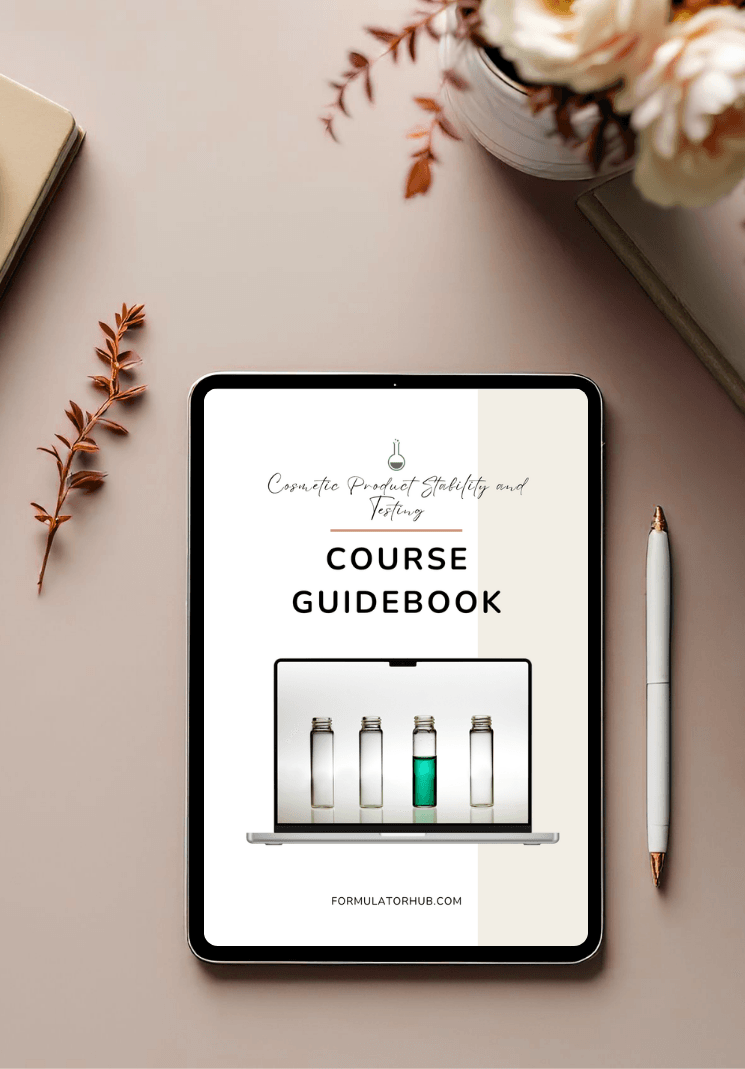
A look inside
CERTIFICATE IN PRODUCT STABILITY & TESTING
How this course is built differently
This course pairs every test with the reasoning, walks you through data from formulations, and gives you access to a cosmetic chemist when your results don't match the textbook. The documentation templates alone would take months to build from scratch.
Every test paired with interpretation guidance
Ready-made documentation templates
Designed for small-scale equipment and budgets
Covers troubleshooting when results surprise you
Case studies with explanations
Two layers of support (AI tutor + cosmetic chemist)
Practical assignment on a real formulation
Certificate for your professional portfolio
Every batch you release without a proper testing process is a batch based on instinct rather than evidence.
What you’ll be able to do after the course
Build a realistic stability plan for your products and equipment.
Decide whether a batch is acceptable, needs watching, or needs to be pulled.
Set expiry dates based on test results.
Keep stability documentation you can use again and again and refer back to.
INTRODUCING
Certificate in Product Stability and Testing
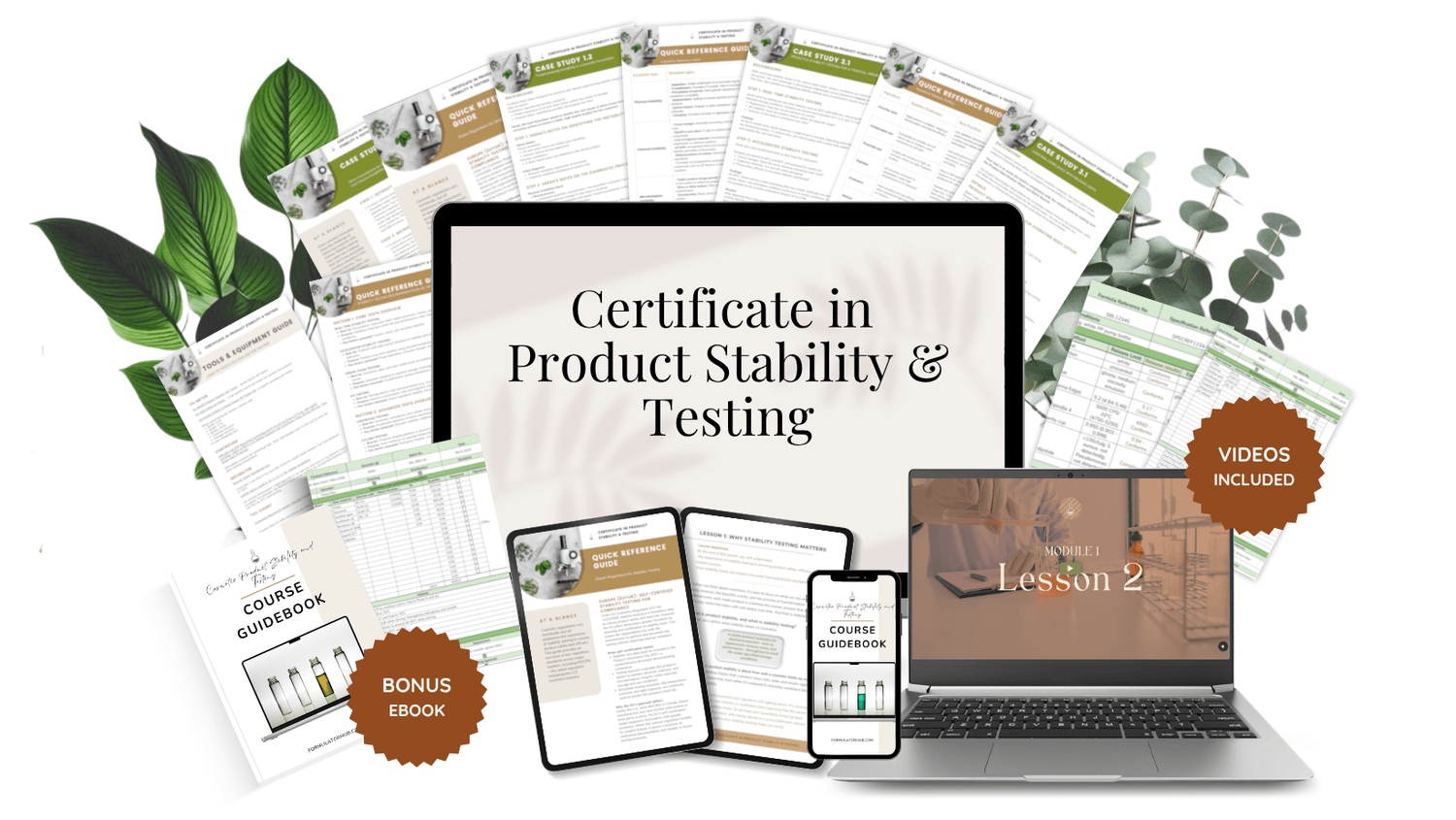
This course teaches professional stability testing designed for small-scale formulators.
It covers what instability looks like and why it happens, which tests to run and what each can tell you, how to document your work and interpret results, so you can make better shelf-life decisions based on real data.
The hardest part to learn on your own is decision-making: when is a colour change cosmetic and when is it degradation? How long do you test before you trust the result? What's the standard for your records? That's where this course spends most of its time.
Built from the same principles I use in my R&D work, adapted for small-scale production with realistic tools and budgets.
Cosmetic chemist support in every lesson, plus Ellie (an AI tutor) for quick reference questions while you work.
The course assumes you can formulate, but doesn't assume any formal background in stability testing.
Video modules | Templates |Checklists & More
WHAT YOU WILL LEARN
Inside the Course Modules
Here’s a quick look at what you’ll cover inside each module of the Certificate in Product Stability & Testing.
Why products become unstable, the different types of instability in cosmetic formulations, and the factors that affect whether a formula holds together over time. This is the science underneath everything else in the course. By the end of this module, you’ll be able to look at a formula and spot where the stability risks are before you’ve even made a batch, so your testing starts with a clear question instead of “let’s see what happens.”
The core tests every formulator should know how to run, plus advanced options for when you need deeper analysis. You’ll cover the parameters you’re testing and the tools and equipment suitable for small‑scale labs and realistic budgets. By the end of this module, you’ll have a complete testing protocol you can apply to any formulation type, and you’ll understand what each test is actually designed to tell you.
Documentation is half the job. This module covers release limits, expiry limits, product specification sheets, and batch records. You’ll build the paperwork systems that turn your testing from casual observation into a process you could hand to a cosmetic chemist or a regulatory body without embarrassment. If someone asked you to prove a product was stable, your records would be able to answer that question.
How to set up your test schedule, prepare samples correctly, interpret what you’re seeing, and troubleshoot when results aren’t what you expected. This is where the course moves from “how to test” to “how to make decisions based on what you find.” By the end, you’ll know what your data is telling you, how to set a shelf‑life date from that data, and when a result needs action rather than simple observation.
Case studies to see the theory in practice; reference files for easy navigation; templates and examples.
HEAR FROM OUR STUDENTS
Testimonials
Be prepared
This is advanced stuff and very different from a formulation course. You need to read, you need to implement, and you need to be patient. Love it!
KIRSTI, Cohort 2025
Best investment for my brand
Stability testing was always a pain, but not any more. I can confidently run my tests and assess the data. Thank you.
MICHAEL, Cohort 2025
So much value
The course and features are fantastic. The Case Studies helped me put everything into practice. I only make body butters, but I now know how to read my stability test results.
AMINA, Cohort 2024

Our Dream Clients
HOW THE COURSE WORKS
Your Path from Test to Decision

Learn
The science of instability and how to design your testing protocol
Apply
Run your tests, document results, and interpret what you find
Decide
Set shelf-life dates and build records for your products
What's included
What you get
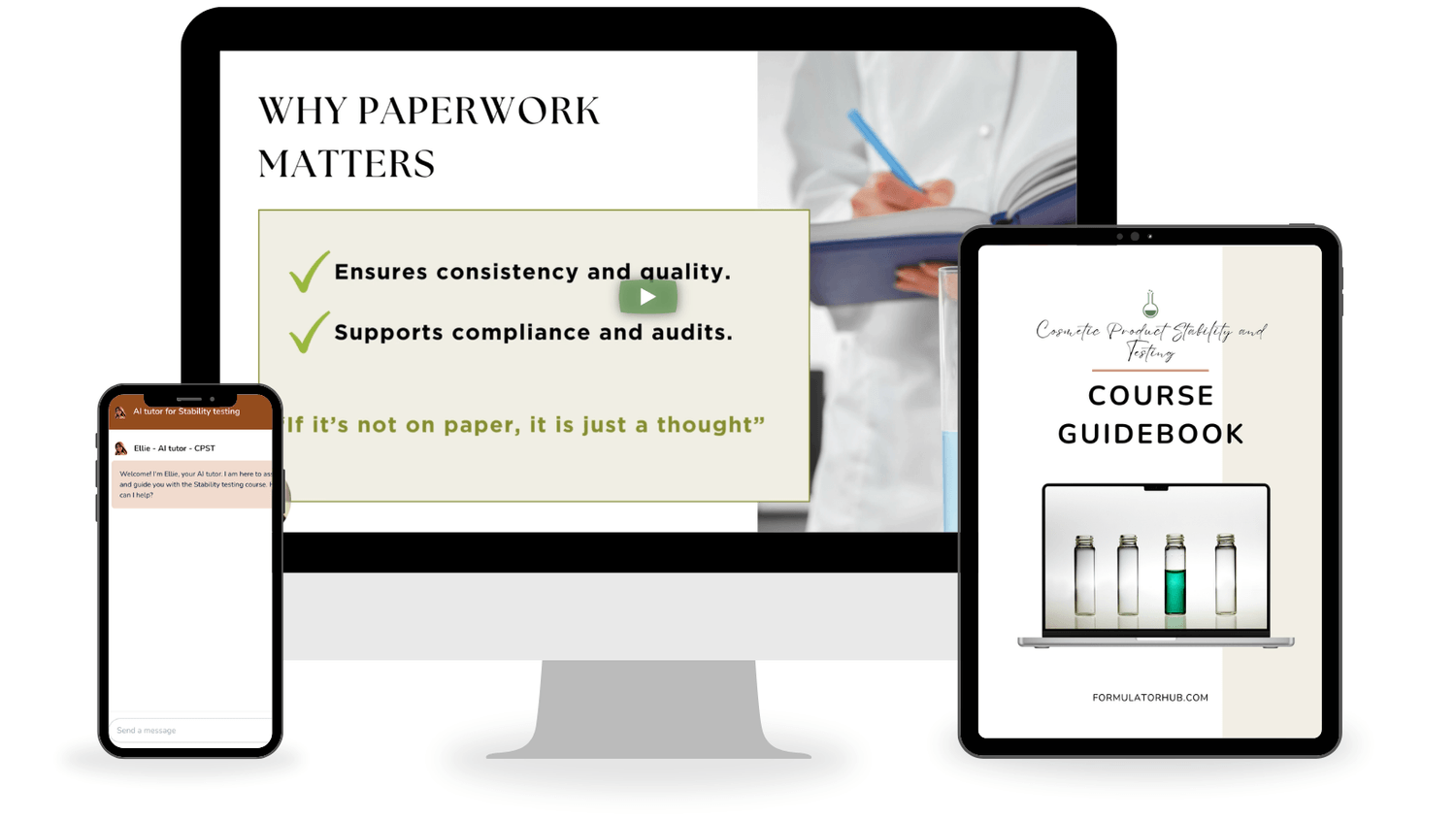
Full course (4 modules, 18 lessons, quizzes) - The complete stability testing process from science through interpretation to decision-making.
Documentation templates - Product specification sheets, batch records, and testing protocol templates that are ready to use.
Case studies - Real stability testing examples so you can see how the process works in practice, including what happened when results weren't straightforward.
Tool and equipment recommendations - What to buy, what to skip, and how to set up testing that works at a small scale without spending a fortune.
Reference guides - A collection of guides, stability testing recommendations by product type, regulations, difficult ingredients and more.
Ellie AI Tutor - AI support for quick reference questions while you learn, available within the course 24/7.
Cosmetic chemist support in every lesson - Post your questions directly where you're learning and get a response from Timi.
Certificate of Completion - Professional documentation of your training.
One payment of $347
for the full course, templates, support, and bonuses.
Or 2 monthly payments of $190
FREEBIES
Did Someone
Say Bonuses?
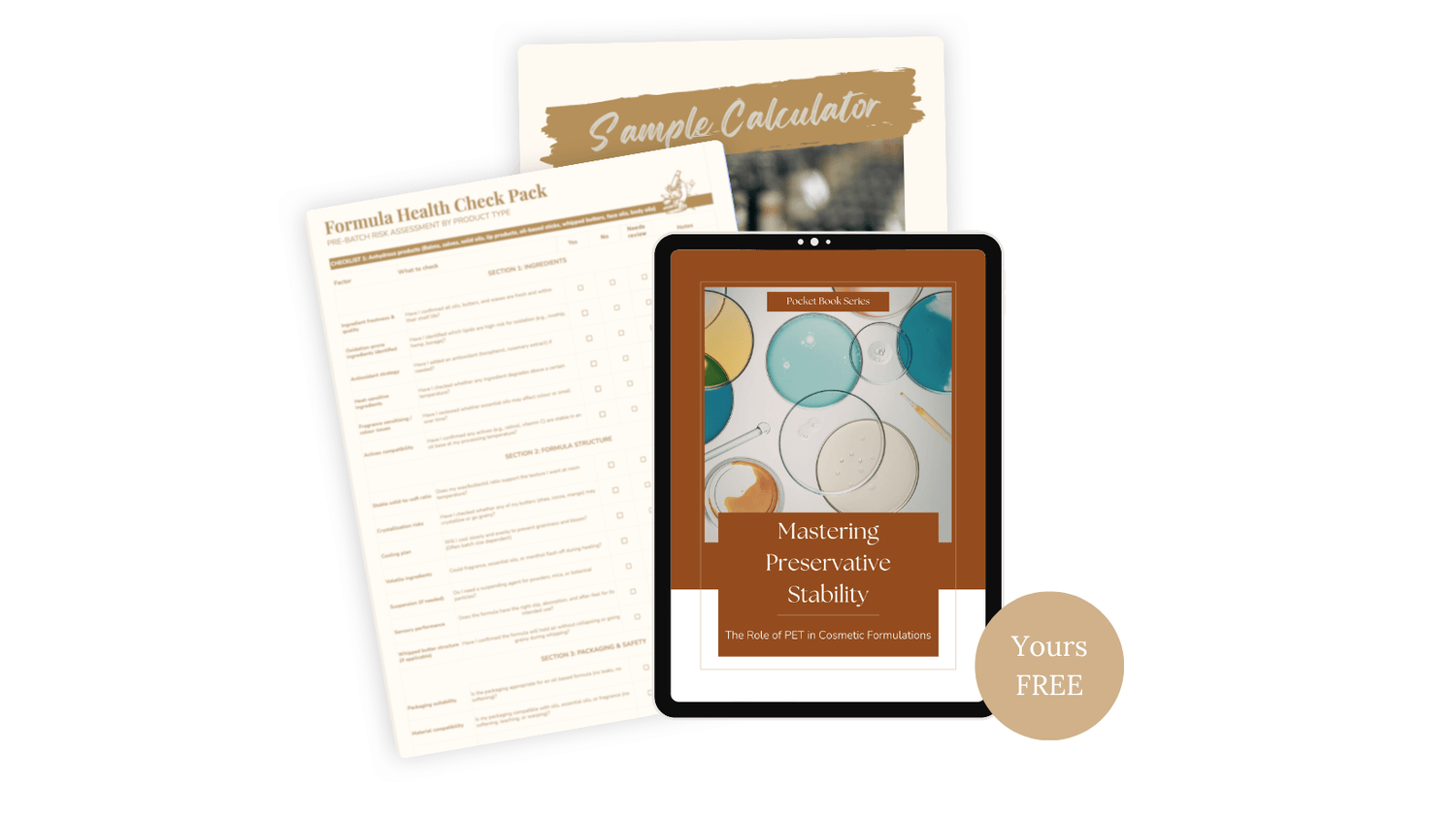
To get you off to your best possible start in Cosmetic Stability Testing, I'm going to add these bonuses FREE when you purchase from today:
Mastering Preservative Stability: The Role of PET in Cosmetic Formulations (ebook) — $27 value
Formulator Stability Checklist 3.0: The Self-Audit Workbook — $47 value
Stability Sample Calculator (spreadsheet) — $27 value
MORE DETAILS
Your Questions Answered
Not necessarily. The course is designed for small-scale formulators and includes specific recommendations for tools and equipment that are realistic for home labs or small production spaces. I've tested the recommendations against what's actually available and affordable. You don't need anything industrial.
If selling is on your radar, learning stability testing before you start means your first products go out with proper testing data. It's easier to build a good process from the beginning than to go back and retrofit one after you've already been selling. If selling genuinely isn't something you're considering, focus on formulation education first and come back to this when the time is right.
Honestly, it might be more relevant. If your current process is informal, or if you've been setting shelf-life dates based on what feels about right, this course gives you the structure and documentation to turn that into something you could rely on if anyone asked. It also gives you the tools to catch problems you might not be seeing yet. Most instability doesn't announce itself with obvious separation. It shows up as slow, subtle changes that are easy to miss without a proper framework.
The Pro Formulator Path includes an overview of stability as part of the Going Pro modules. This course goes much deeper. It's a full certificate course covering the science, the testing methods, the documentation systems, and the interpretation of results. If you've done the PFP and want to build a thorough stability practice, this is the next step. If you haven't done the PFP, that's fine too. This course assumes you can formulate, but doesn't assume any formal background in stability testing.
The content itself can be covered in about a week of focused study. But stability testing by nature takes time, because you're running tests over weeks and months and observing results at intervals. The 12 months of access is there for that reason. You'll learn the material, then apply it to real formulations, and you'll likely come back to specific sections as new questions come up during your testing. That's how it's designed to work.
Two layers. Ellie is an AI tutor available inside the course for quick reference questions while you work, things like "what temperature should I use for accelerated testing" or "what does this parameter mean." On top of that, every lesson includes direct support from a cosmetic chemist, where you can post technical questions and get a response from Timi. The deeper questions, the ones about interpreting ambiguous results or making judgment calls on your specific formulation, those are what the human support is there for.
You can find checklists and general guidance, and some of it is reasonable. What's harder to find is the part that actually matters: what to do when results aren't clear-cut, how to tell the difference between a cosmetic change and real instability, how to decide when you've tested enough, and how to document your process in a way that's professionally defensible. That interpretation and decision-making layer is where most free resources stop, and it's where this course spends most of its time.
Yes. On completion, you receive a Certificate in Product Stability and Testing. It's a professional credential for your portfolio and documentation of your training in this area.

Hello!
I'm Timi.
A Cosmetic Chemist with 10 years experience helping formulators hone their skills.
I built this course because so many schools omit this part of the formulation process, even though it is, in fact, essential.
I saw formulators who were good at making products but had no structured way to test whether those products would stay stable over time. Some were already selling, some were about to. And most of them relied on short-term observations and completely ignored testing, thinking, "it's not mandatory". Well, in a way, it is, so let's do this well.
I work in R&D at a luxury cosmetics brand, and I've been teaching cosmetic formulation since 2015. Stability testing has been part of my professional practice for over a decade, across hundreds of formulations and product categories, including emulsions and serums, surfactant systems, and anhydrous products.
This course teaches the same principles I use in my R&D work, adapted for small-scale production with realistic tools and budgets.
I've also taught many students through Formulator Hub. The questions that come up around stability are remarkably consistent, and they're almost never about which tests to run. They're about what the results mean, where the line is, and how to document what you've found. That's what this course is built around.
Lets Go!
The next time you finish a batch and find yourself wondering whether it'll still look, feel, and perform the same way in 3, 9 or even 12 months, you could have a process that answers that question with data.
This course gives you that process and the decision steps to use it well.
Free Resource
Not sure what's in a product?
Decode any cosmetic ingredient list in minutes with Lexie, the Cosmetic Label Decoder.
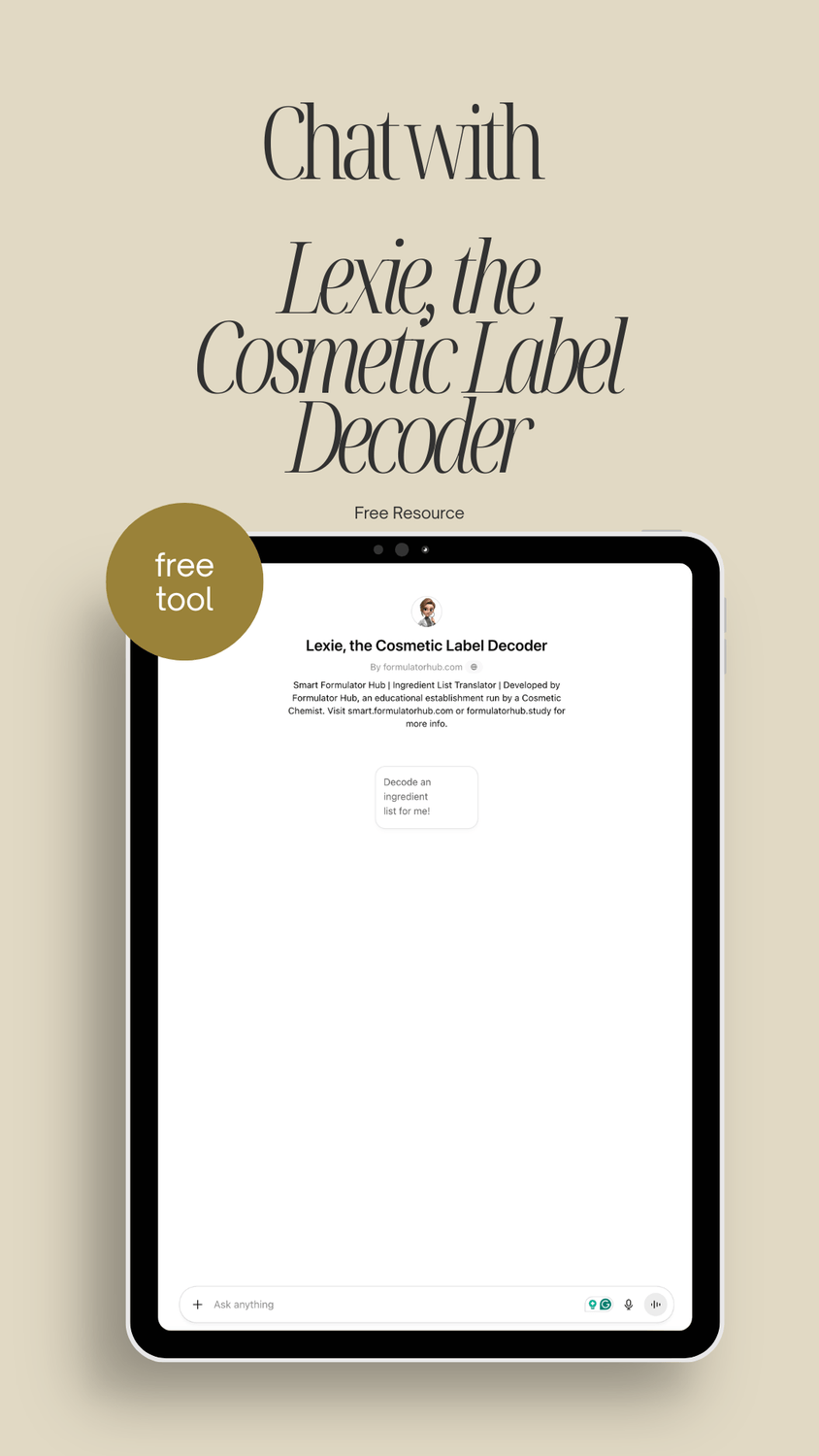
Lexie is a free AI assistant I trained to walk you through INCI lists the way a formulator would.
She'll tell you what each ingredient is, what it's doing in the formula, and how it fits with everything else on the list.
It's a good place to start if you're new to reading labels, and a useful reference if you're already formulating.
To chat with Lexie, you will need a ChatGPT account (a free account works).
Attention: For formulators who want to test their products and interpret the results!

About Formulator Hub
Learn to formulate cosmetics from the ground up. Understand your ingredients, build formulas that hold together, and know what to do when something doesn't behave.


Inspiration in your Inbox!
Free Signup
© 2026. All Rights Reserved