

Formulate a tri-phase nail serum
ABOUT THE FORMULA
Healthy nails need regular care, and if you’re anything like me and refuse to wear gloves for washing up, you’ll know how quickly your nails, cuticles, and hands start to show it.
This tri-phase nail serum comes in a dropper bottle with three distinct layers that combine when shaken into a single blend you apply straight to your nails and cuticles. Once it settles, it separates back into its three phases, which is what makes this formula visually interesting and surprisingly practical.
The tri-phase effect works because each layer has a different polarity. Polarity, in simple terms, is how attracted a molecule is to water.
Water is highly polar, so the water-based ingredients in Phase A tend to sink to the bottom.
The alkane in Phase C is non-polar, so it rises to the top.
And castor oil sits in the middle because it's more polar than most carrier oils, thanks to the hydroxyl group on its ricinoleic acid. That extra polarity is enough to keep it separate from the alkane above, but it's still too oil-like to mix with the water below.
This is why the ingredient choices in this formula are quite specific. Most carrier oils, such as sweet almond, jojoba, or argan, aren't polar enough to form a distinct layer. They'd simply dissolve into the alkane, and you'd end up with two phases instead of three. Castor oil's unusual chemistry is what makes the middle layer possible, and that's the detail that turns this from a nice-looking product into a genuine formulation lesson.
When you shake the bottle, you temporarily force all three polarities together. The mixture appears uniform for a moment, indicating that the actives from each phase are delivered to the nail and cuticle simultaneously. Then, once the energy from shaking dissipates, the molecules reorganise themselves by polarity and the layers reform. It's the same principle that explains why oil-and-vinegar salad dressings separate in the bottle, just with a third layer added.
HOW TO USE
Shake the bottle well before each use to ensure the three layers mix. Apply a couple of drops to your nails and cuticles, massage it in, and that’s it. Use as often as you like.
ABOUT THE INGREDIENTS
Here’s what you’ll need and what each ingredient does in this formula:
Distilled water: The solvent base for the water phase. It carries the water-soluble actives and gives the serum its hydrating layer.
Glycerin: A humectant that draws moisture to the nail and cuticle area. At 5%, it adds hydration without making the water phase sticky.
Panthenol: A vitamin B5 derivative that supports nail flexibility and helps condition the cuticles. It’s a useful ingredient in any nail care product.
Caramel colourant: An organic colourant (made from sugar) that gives the water phase a warm amber tone. It’s purely aesthetic, but it makes the phase separation more visible and the finished product more appealing.
Euxyl K712: The preservative for the water phase. Because this formula contains water, it needs to be preserved. Euxyl K712 works well in the pH range we’re targeting (4.8–5.2).
pH adjuster: Used to bring the water phase into the correct pH range for the preservative to function. You’ll adjust this after blending Phase A.
Castor oil: The main emollient. Castor oil is thick and conditioning, with a particular affinity for nails and cuticles. At 29%, it’s the dominant phase in this formula. I don’t normally use this much castor oil in products, and I was a bit apprehensive at first, but it works well here because it absorbs into the nail area without leaving a heavy residue on the hands.
Rosehip CO2 extract: A botanical addition to the oil phase. It adds colour and skin-conditioning properties. In my first version, I also included carrot tissue oil at 2%, which gave the serum a more orange appearance. In the next version, I removed it and kept the rosehip extract.
Sweet orange essential oil: A light citrus fragrance that complements the warm tones of the oil phase. At 0.10%, it’s well within safe usage levels for a leave-on product.
Tocopherol: An antioxidant that protects the oils in the formula from oxidation. It helps keep the castor oil and rosehip extract stable over time.
Dry Touch (alkane): The top layer. This is a non-polar emollient, also called Dry Touch from Aroma Zone. The INCI is dodecane (you can also use products like EMOGREEN™ L19 from Seppic, INCI: C15-19 Alkane). You can’t use natural oils or esters here because they won’t separate cleanly from the castor oil. Olive squalane is another option worth trying.
What you’ll need:
A digital scale (accurate to 0.01g), a beaker or small jug for each phase, a glass stirring rod or small spatula, pH strips or a meter, a dropper bottle (glass works best for presentation), and gloves.
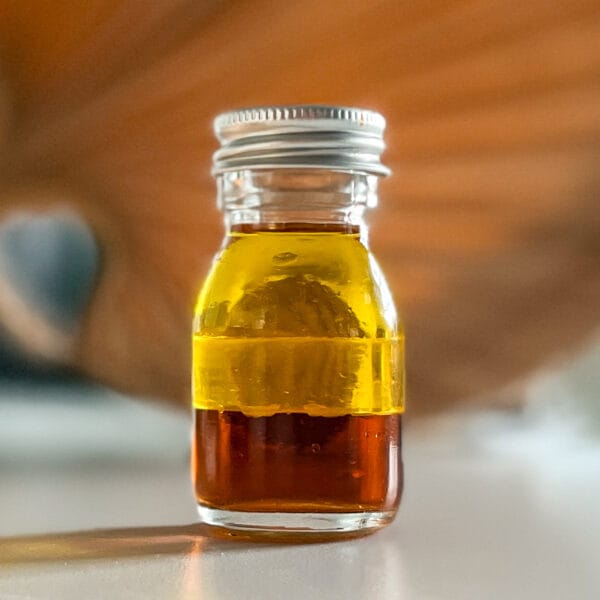
With 2% carrot macerated oil - after separation
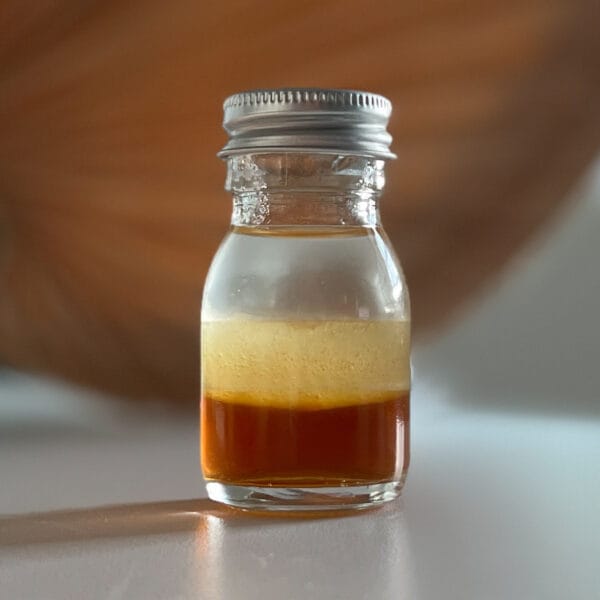
Without 2% carrot macerated oil - after separation
POSSIBLE SOURCES
This is where I purchased my key ingredients:
Caramel colour: EU or US suppliers carry organic caramel colourants made from sugar.
Alkane (Dry Touch / Dodecane): Aroma Zone (EU) or equivalent US suppliers. EMOGREEN™ L19 from Seppic (INCI: C15-19 Alkane) is a good alternative.
Check your usual suppliers for the remaining ingredients. Castor oil, glycerin, panthenol, rosehip CO2 extract, sweet orange essential oil, and tocopherol are all widely available from cosmetic ingredient suppliers.
THE FORMULA
| Phase | Ingredient | Function | % w/w |
|---|---|---|---|
| A | Distilled water | Solvent | 34.20 |
| A | Glycerin | Humectant | 5.0 |
| A | Panthenol | Vitamin, active | 0.90 |
| A | Caramel colourant | Colourant | 0.30 |
| A | Euxyl K712 | Preservative | 0.60 |
| A | pH adjuster | pH adjuster | qs |
| B | Castor oil | Emollient | 29 |
| B | Rosehip CO2 extract | Added extra, botanical | 0.30 |
| B | Sweet orange essential oil | Fragrance | 0.10 |
| B | Tocopherol | Antioxidant | 0.20 |
| C | Dry Touch (Alkane) | Emollient | 30.0 |
Method
1. Blend Phase A. Adjust pH to be 4.8–5.2. This is needed for the preservative.
2. Blend Phase B.
3. Blend Phase C.
4. Add each phase to your dropper bottle.
* It may take a while for the castor and alkane to separate; just allow some time for them to settle.
** If you want the more orange version, add 2% carrot macerate and reduce the castor to 27%.
WHY THIS FORMULA IS WORTH MAKING
Understanding polarity in practice - Most formulation courses talk about polarity in theory, but this formula lets you see it. The water, oil, and alkane layers separate because of their molecular differences, and watching that happen in your own bottle is a better lesson than any textbook diagram.
Working with castor oil at a high percentage - Castor oil behaves differently from most carrier oils. It’s viscous, it has a distinctive skin feel, and at 29%, it dominates the oil phase here. Getting comfortable with how it performs at this level is useful knowledge for nail care, lip products, and hair formulations where castor oil is commonly used.
Learning to preserve a water phase in a multi-phase product - Even though this product separates into layers, the water phase still needs proper preservation. Understanding that water-containing phases always need a preservative, regardless of the overall product format, is a principle that applies to every formula you’ll ever make.
Choosing the right non-polar ingredient - The top layer can’t be just any oil. It has to be non-polar enough to separate cleanly from the castor oil underneath. That decision point, choosing an ingredient based on its polarity rather than just its skin feel, is a formulation skill that gets more important as your products get more complex.
This is also one of those formulas where the finished product looks genuinely impressive sitting on a shelf, which is always a nice bonus when you’re putting the work in.
MAKE IT YOUR OWN
Castor oil is the one ingredient you can't really swap in this formula. Its polarity and viscosity are what allow it to sit as a distinct middle layer between the water phase and the alkane. If you replace it with a lighter carrier oil, like sweet almond or argan, that oil will most likely blend with the alkane layer rather than separating, and you'll lose the tri-phase effect. If you want to understand more about why different carrier oils behave so differently in formulations, my Pocket Guide to Carrier Oils is a good place to start.
You can experiment with the water phase and the top layer.
Distilled water → hydrosols (rose, chamomile, or lavender) — You can replace some or all of the distilled water with a hydrosol for added skin benefit and a light natural scent in the water layer. Keep an eye on the pH after swapping, as hydrosols can sit at different pH levels, and your preservative still needs to work within its effective range.
Panthenol → allantoin or sodium PCA — Both are water-soluble actives that work well in nail and cuticle care. Allantoin is soothing and supports skin repair. Sodium PCA is a natural moisturising factor that helps with hydration. Check solubility limits before adding.
Sweet orange essential oil → lemon, mandarin, or lavender — Keep the total fragrance percentage around 0.10% for a leave-on product and check your IFRA guidelines. Lemon and mandarin add a fresh citrus note; lavender takes it in a calmer direction.
Dry Touch (dodecane) → olive squalane or EMOGREEN™ L19 — The key requirement for this layer is that it's non-polar enough to separate from castor oil. Natural oils and esters won't work here because they'll blend with the castor rather than sit on top. Squalane is worth a try, though the separation may be less visually clean.
Understanding which ingredients can move and which ones are structural is one of the most useful formulation skills to develop. In this formula, the castor oil and the alkane are structural. Everything else has room to play.
SAFETY NOTE
This formula is designed for personal use as a leave-on nail and cuticle treatment. It contains essential oil at a low percentage (0.10%), but always check the IFRA guidelines for your specific oil to confirm it’s within safe usage levels for leave-on products.
Because the formula contains a water phase, preservation is essential. Euxyl K712 requires a pH of 4.8–5.2 to work effectively, so make sure you check and adjust the pH of Phase A before adding it to the bottle. If you swap the preservative, check the effective pH range of your chosen system and adjust accordingly.
Always perform a patch test before using a new product on your nails and cuticles regularly. Apply a small amount to the inside of your wrist, leave for 24 hours, and check for any irritation.
When sourcing your ingredients, purchase from reputable suppliers who provide proper documentation, including Certificates of Analysis (COAs) and Safety Data Sheets (SDS). If you’re using any fragrance materials, request the IFRA certificate.
This blog post is for educational purposes only and is not intended to replace cosmetic safety assessments required for commercial sales. If you plan to sell products, a formal safety assessment by a qualified assessor is a legal requirement in the UK and EU.
The 29% castor oil was the part of this formula I was least sure about, and it turned out to be what makes the serum work so well. It coats the nails and cuticles thoroughly without leaving your hands feeling oily, unlike the usual complaint with castor-heavy products. Sometimes the ingredient you’re hesitant about is the one that teaches you the most.
If you make this one, I’d love to know what you think of the tri-phase effect once it settles.
Do you get a clean separation, or does your version stay a bit cloudy? Join our SKOOL Community and let me know.
Join our free SKOOL Community for more resources!
YOU MIGHT ALSO LIKE


About Formulator Hub
Learn to formulate cosmetics from the ground up. Understand your ingredients, build formulas that hold together, and know what to do when something doesn't behave.


Inspiration in your Inbox!

Free Signup
© 2026. All Rights Reserved