

How to follow GMP in a home lab: A Practical Guide for Small Cosmetic Makers
INTRODUCTION
I've been teaching cosmetic formulation through Formulator Hub since 2015, and I also hold a GMP internal auditor qualification, so I see both sides of this: the formulators trying to make sense of the requirements, and the audits where the records either hold up or they don't.
Many formulators have this kind of reaction when GMP comes up for the first time. They ask questions like
What on earth is GMP?
Isn't it for big manufacturers only?
I make cosmetics in my kitchen. How do I even start preparing for GMP?
Most small cosmetic makers assume GMP was written for factories. The thirteen areas covered by ISO 22716, the language about controlled environments and documented systems, reads as if it belongs to someone with a stainless steel bench and a dedicated clean room. But GMP applies at every scale, and you can follow it from a spare room or kitchen bench. The principles are the same, but the systems are just smaller.
Today I want to talk about what GMP actually asks of you at home scale, area by area, with enough detail that you can start putting things in place this week.
YOUR WORKSPACE IN A HOME LAB
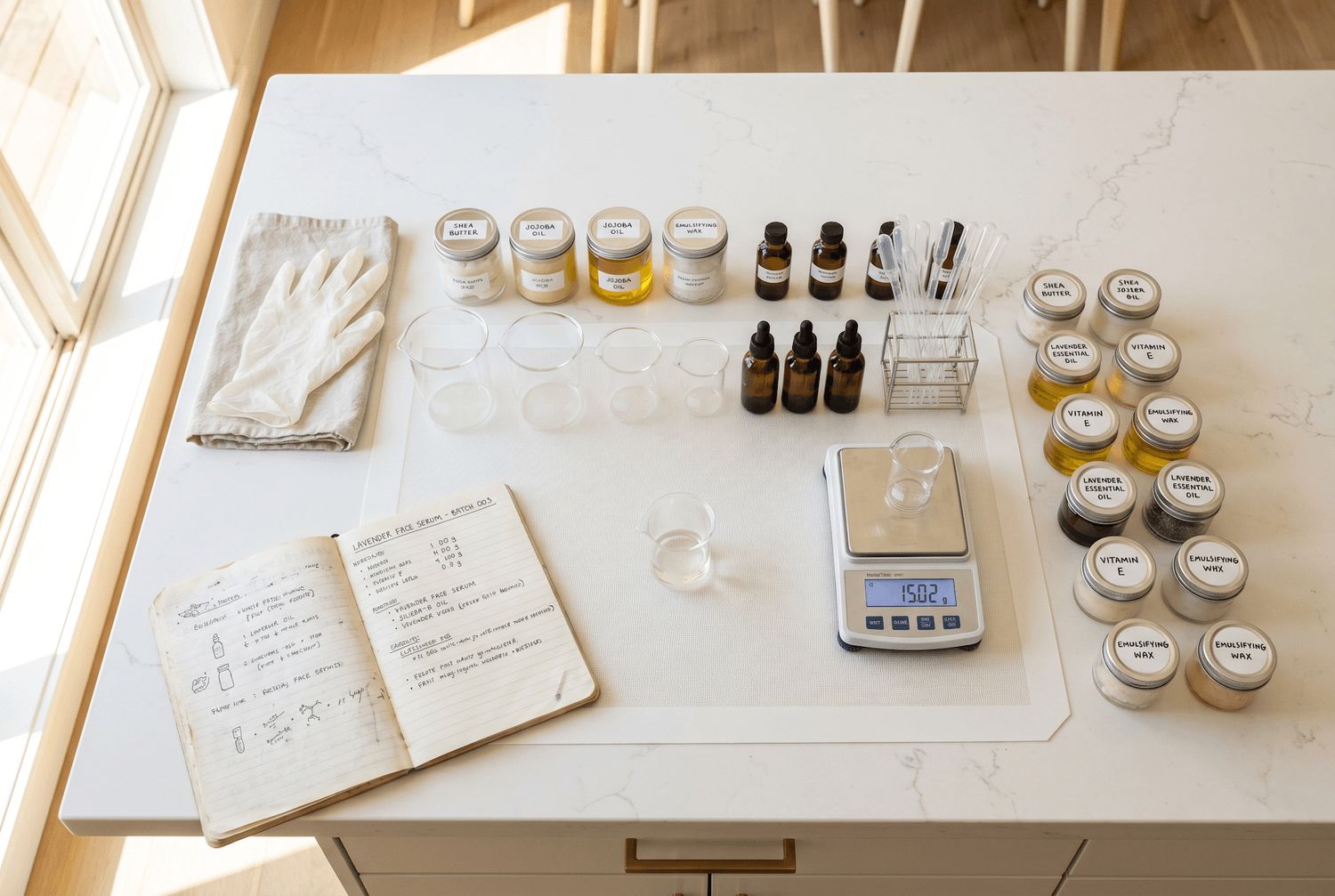
GMP expects your production area to be clean, organised, and suitable for the products you're making. For a home lab, that means a workspace you can dedicate to production when you're making products, separated from food preparation and other household activities during those sessions.
You don't need a permanent dedicated room, though it helps. What you do need is the ability to clean and prepare the space before production, control what comes into contact with your products, and keep it free from contamination sources while you work. Pets, cooking, open windows with dust and pollen, and other household members moving through all count.
Think about your surfaces, lighting, ventilation, and access to water. If you're working in a kitchen, you'll need to clean all work surfaces thoroughly before and after production, and you'll want to store your production equipment separately from household items. A dedicated cupboard or shelving unit for your formulation equipment is a simple starting point.
YOUR DOCUMENTATION SYSTEM
Documentation is the foundation of GMP. Without it, everything else you do is untraceable, really.
The core documents you need at a small scale are:
Batch records. Every batch you make should have a record that captures the date, the product name, a batch number, and who made it. Every ingredient with the actual weight used and the supplier's lot number. The production method you followed, including which version of your SOP you used. Record process details, including temperatures, mixing times, and the pH of the finished product. And observations, anything that was different, unexpected, or worth noting during production. That last category is where you'll find real diagnostic value. A batch record full of numbers but no observations tells you what happened, but not how it went.
Standard Operating Procedures (SOPs). A written procedure for each product you make, detailed enough that someone else could follow it and get the same result. Include the method step by step, the equipment needed, the process parameters (temperatures, speeds, times), and any critical points where things can go wrong. Your SOPs will change as you refine your process, and that's expected. Version-control them (v1, v2, v3), so you always know which version is current and which version was used for any given batch.
A cleaning log. What was cleaned, when, how, with what, and by whom. More on this in the cleaning section below.
A raw material intake record. What you received, when, from which supplier, with which lot number, and any observations about condition on arrival. This is what makes your ingredients traceable.
If you're not sure whether you're recording the right things, start with these four documents and build outward from there. There's no universal checklist that covers every product type, but these cover the essentials for any small maker.
YOUR CLEANING ROUTINE
In a home environment, "clean" usually means tidy and visibly free of residue.
GMP asks for something more specific: free from contamination that could affect the quality or safety of your next product. That includes residue from previous batches, microorganisms, dust, and anything carried in from the surrounding environment.
For a home lab, a practical cleaning system looks like this:
Write a cleaning SOP that lists everything you clean (equipment, surfaces, storage containers, utensils), what you use to clean them, how you clean them, and how often. Some things you clean before and after every production session. Others you clean weekly or after specific events, such as spills or product changeovers.
Keep a cleaning log: a simple table with the date, what was cleaned, the cleaning agent used, and your initials. Fill it in each time. This is the evidence that your routine is being followed consistently.
Think about your cleaning agents. Washing-up liquid is fine for removing visible residue, but you may also want isopropyl alcohol or a specific sanitiser for surfaces and equipment that come into direct contact with your products. Know what you're using and why.
The goal here is a routine you can maintain. An elaborate cleaning protocol you abandon after two weeks is worse than a simple one you follow every time.
YOUR EQUIPMENT AND CALIBRATION
GMP expects your equipment to be in good working order, suitable for the job, and, where relevant, checked for accuracy.
For most home formulators, that means three things: your scales, your pH meter, and your thermometer.
Scales. Check your scale against a known reference weight regularly. Calibration weights are inexpensive and available online. Weigh the reference weight, note the reading, and record whether it was accurate or needed adjustment. If your scale reads 2% high on every measurement, every ingredient in every batch is slightly wrong, and you'd never know without checking.
pH meter. Calibrate with pH 4 and pH 7 buffer solutions before each use. Record the calibration in your batch notes. A drifting pH meter can mean your preservation system isn't maintaining the pH you think it is, which is a safety issue.
Thermometer. Check against a known reference point (boiling water at sea level is 100°C, ice water is 0°C). Record the check. Temperature matters for emulsification, for phase additions, and for the stability of heat-sensitive ingredients.
You don't necessarily need laboratory-grade calibration certificates. You need a system for checking your instruments and a record to show you've done so. A note in your batch record that says "pH meter calibrated with pH 4 and pH 7 buffers before use" is a meaningful step.
YOUR RAW MATERIALS AND STORAGE
GMP expects you to know what you've got, where it came from, and that it's been stored properly.
For a home lab, that means:
Labelling. Every ingredient should be clearly labelled with the product name, the supplier, the lot number, the date you received it, and the date you opened it. If you've decanted something from a larger container into a smaller one, the smaller container needs the same information. Unlabelled ingredients are one of the most common GMP problems I see in small-scale setups.
Storage conditions. Different ingredients have different requirements. Oils and butters should be stored away from heat and direct light. Water-soluble ingredients and preservatives often need cool, dry storage. Some actives need refrigeration. Check your supplier's storage recommendations and follow them. If your spare room gets warm in summer, that matters.
Separation. Keep raw materials, finished products, and packaging materials in separate areas or on separate shelves. Keep anything quarantined (ingredients you haven't checked yet, products that failed a quality check) visibly separated from approved stock. This prevents mix-ups, which is one of the core objectives of GMP.
Traceability. Your raw material records and batch records should be linked. If an ingredient is later found to be contaminated or recalled by the supplier, you need to be able to identify every batch of finished product it went into. That's only possible if you've recorded the supplier lot number for each ingredient in each batch record.
COMPLAINTS, DEVIATIONS, AND WHAT TO DO WHEN SOMETHING GOES WRONG
GMP doesn't assume everything will go perfectly. It assumes things will occasionally go wrong, and it wants you to have a system for dealing with them.
Deviations. If something happens during production that wasn't part of your SOP, record it. The pH was lower than expected; you had to mix for longer; the room was warmer than usual; you ran out of one ingredient and substituted another. A deviation record captures what happened, why, what you did about it, and whether it affected the finished product. This is how you learn from problems and prevent them from repeating.
Complaints. If a customer reports a problem with a product, record it. What the problem was, which product, which batch number, and what you did in response. Even if it turns out to be a non-issue, having the record matters. If a pattern emerges across multiple complaints, your records are what help you trace the cause.
At a small scale, these don't need to be elaborate systems. A dedicated notebook or a simple spreadsheet works. What matters is that you have a place to record these things and that you actually use it.
WHERE TO START
If you're reading this, I'm sure you're feeling the weight of it. GMP covers a lot, and implementing it all at once would overwhelm anyone.
Pick one area and start there. For most small makers, batch records are the best first step because they force you to pay attention to everything else: your ingredients, your process, your parameters, your observations. Once batch records become a habit, add your cleaning log. Then your raw material intake records. Then calibration checks. Build it gradually, layer by layer.
GMP was never designed to be implemented overnight, even in large facilities. At small scale, building it gradually is the only approach that sticks. The discipline does become routine. There is a point at which filling out a batch record feels no different from washing your hands before you start. Getting there takes time, but every maker I know who's done it says the same thing: they wish they'd started earlier.
Join our free SKOOL Community for more resources!
YOU MIGHT ALSO LIKE

About Formulator Hub
Learn to formulate cosmetics from the ground up. Understand your ingredients, build formulas that hold together, and know what to do when something doesn't behave.


Inspiration in your Inbox!
Free Signup
© 2026. All Rights Reserved