

Are Parabens Safe? What Cosmetic Formulators Actually Need to Know
INTRODUCTION
If you've been formulating for any length of time, you've almost certainly had the paraben conversation. Someone asks what preservative you use, and the moment you mention parabens (or even consider them), the response is immediate: aren't those dangerous?
The short answer, based on the current body of evidence, is no. At permitted usage levels, parabens are considered safe by every major regulatory body, including the EU Scientific Committee on Consumer Safety (SCCS), the UK's regulatory framework, and the US FDA. They've been used in cosmetics for over 80 years, and they remain among the most thoroughly researched preservative ingredients available to formulators.
Where did the fear come from, and why does it persist?
To be honest, I held this belief myself for longer than I'd like to admit.
I avoided parabens (for example, Germaben II) for years, chose alternatives that sounded better on paper, and then spent a frustrating amount of time trying to work out why my products were failing challenge tests or simply not working well in my formulas.
It took a conversation with a cosmetic chemist I respect, one who looked at me like I'd said the earth was flat, for me to go back and actually read the research.
What I found was that the science had been clear for a while. I'd just never looked at it because I thought I already knew the answer.
The 2004 Study and What It Actually Found
Most of the concerns about parabens can be traced back to a 2004 study by Philippa Darbre and colleagues, published in the Journal of Applied Toxicology.
The study detected parabens in breast cancer tissue samples. Headlines ran with the implication that parabens cause cancer.
But what the headlines left out was significant. The study did not establish a causal link between parabens and cancer. It didn't include a control group of healthy tissue for comparison. It didn't demonstrate that the parabens found in the tissue came from cosmetic products. And the concentrations detected were extremely low.
The scientific community responded with extensive follow-up research. The SCCS reviewed the evidence multiple times, most recently confirming that methylparaben and ethylparaben are safe at concentrations up to 0.4% individually or 0.8% combined. Butylparaben and propylparaben were reassessed with lower limits (0.14% as a sum of their individual concentrations), reflecting a more cautious approach to the longer-chain parabens, but still within the "safe to use" category.
The point here is that the "parabens cause cancer" claim is not supported by the weight of evidence. It's a conclusion that was drawn from a single study, amplified by media coverage, and then reinforced by marketing.
WHY "PARABEN-FREE" BECAME A SELLING POINT?
Once the fear was established, the market responded: "Paraben-free" became a label that signalled safety, cleanliness, and natural credentials, even though it doesn't actually tell you anything about whether the product is well-preserved or safe.
For brands, it was an easy win. Removing parabens and replacing them with alternatives (some well-tested, some less so) allowed companies to charge more for products marketed as "clean" or "natural." The consumer felt reassured. The formulator, however, was left with a smaller toolkit and, in many cases, a harder preservation challenge.
This is where it gets relevant for you as a formulator. If you're avoiding parabens because your target market expects "paraben-free" products, or because a certification standard like COSMOS requires it, that's a legitimate formulation decision. You're making a choice based on brand positioning or regulatory compliance, and that's fine. You just need to make sure your alternative preservation system actually works.
Another suggestion is to educate your customers about your point of view and your decision to use or avoid parabens, but ensure these are based on science, not fear.
WHAT I ACTUALLY RECOMMEND
My position on parabens is straightforward: they are a legitimate, well-studied option for cosmetic preservation. I don't think every formula needs them, and I don't think formulators should default to them without considering their specific formula parameters. But I also think avoiding them out of fear, when the science doesn't support that fear, is a mistake that can compromise product safety.
Here's what I'd suggest if you're working through this decision:
Read the regulatory assessments yourself. The SCCS opinions on parabens are publicly available. They're dense, but the conclusions are clear. Forming your own view based on the actual science is worth the time.
Understand the preservative you're choosing. Whether it's parabens, phenoxyethanol, a blend system, or something else entirely, you need to know its effective pH range, its compatibility with your other ingredients, and its limitations. Every preservative has conditions under which it works and conditions under which it doesn't.
Match the preservative to the formula. This is the part that matters most. Your formula's pH, water content, challenge ingredients, and packaging all affect which preservatives will be effective. Choosing a preservative without considering these factors is like choosing a shoe without knowing the size. It might work. It probably won't.
Don't confuse marketing categories with safety categories. "Natural" doesn't mean safe. "Synthetic" doesn't mean dangerous. "Paraben-free" doesn't mean well-preserved. These labels describe marketing decisions, not formulation quality.
Do you need help with choosing preservatives?
MAKING BETTER PRESERVATIVE DECISIONS
The fact that you're reading this blog post about preservation science rather than just picking whatever has the friendliest label tells you something about the kind of formulator you are. You're someone who wants to understand the evidence before making the decision, and that's exactly the right instinct.
If you're finding the preservative selection process overwhelming, that's understandable. There are hundreds of preservatives available to cosmetic formulators, each with different pH ranges, solubility profiles, regulatory statuses, and compatibility considerations. Cross-referencing all of that manually, for every formula, takes real time and expertise.
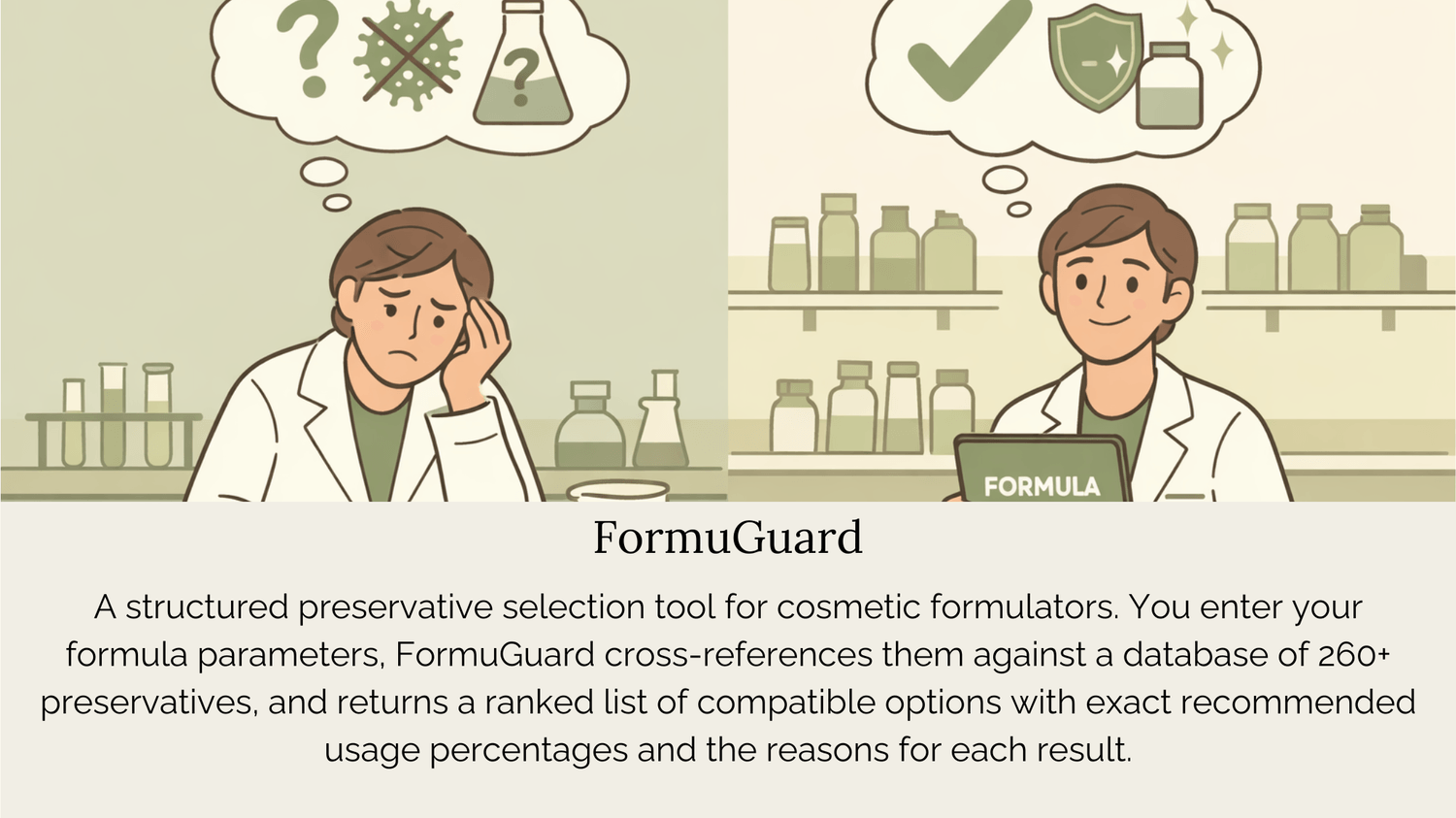
That's the problem I built FormuGuard to address. You enter your formula parameters (product type, pH range, water content, challenge ingredients, packaging format), and it returns a ranked list of compatible preservatives with exact recommended usage percentages and clear reasons for each result. It doesn't make the decision for you, but it gives you something solid to base it on.
If you'd like to try it, there's a free 24-hour trial at guard.formulatorhub.com. No payment details required.
Join our free SKOOL Community for more resources!
YOU MIGHT ALSO LIKE

About Formulator Hub
Learn to formulate cosmetics from the ground up. Understand your ingredients, build formulas that hold together, and know what to do when something doesn't behave.


Inspiration in your Inbox!
Free Signup
© 2026. All Rights Reserved