


Three methods. One course.
Solid shampoo bars made clear
How Shampoo Bars Work, and How to Formulate Your Own
A focused course covering three methods, full ingredient walkthroughs, and a customisation guide for different hair types. You'll understand what goes into your formula and why, which means you can troubleshoot problems instead of starting over.
The Real Problem
WHY THIS COURSE EXISTS
There are a million ways to make a shampoo bar. That's exactly why most people get stuck.
Search for shampoo bar tutorials, and you'll find dozens of methods, dozens of formulas, and a lot of confident advice that contradicts itself.
Add water or don't.
Use BTMS or never use BTMS.
Use SCI on its own or always combine it
Preserve or don't bother because it's anhydrous.
Every source sounds sure of itself, and none of them agrees.
I've been teaching shampoo bar formulation for many years, and this is the pattern I see over and over: A DIY formulator finds a recipe, but it doesn't work for some reason. They go off to Google, find a different one, and end up with contradictory information and more confusion. The result is that they have no idea who or what to trust. The more they read, the less certain they feel.
That's why this course is anchored on three methods, the three structural approaches I personally use that cover how solid shampoo bars are actually built.
You'll understand why each one exists, what it's good at, where it falls short, and which one fits your setup. And the misconceptions that float around online, such as the BTMS question, the water question, and the preservative question, are all addressed directly, so you can form your own opinion and pick the approach that suits your setup.

"A beautiful, colourful shampoo bar starts with clever ingredient choices, luscious lather, and a formula designed with a specific hair type in mind."
Time for change
A few things that might sound familiar:
You've made shampoo bars before, but they came out too soft, or crumbly, or harsh on the hair, and you couldn't work out what went wrong or what to change.
You've collected recipes from different sources, and they all contradict each other. You're not sure which advice to trust or which approach is actually sound.
You can follow instructions, but if someone asked you why you chose that surfactant or that percentage, you'd struggle to give a clear answer.
I know the frustration you feel is real. I know you're putting in real effort, but you don't have a framework for understanding
what's happening in your formula.
And I'm here to change that.
INTRODUCING
Shampoo Bar Lab
This course teaches solid shampoo bar formulation from the ingredients up.
You'll learn three methods, understand what every component does in your formula, and build bars you can adjust for different hair types.
HOW THE COURSE IS STRUCTURED
Built on my signature EFD™ Method
Every course I build follows the same three-stage teaching framework I've developed over the last decade.
I call it the EFD™ Method, and it's the reason my students don't just follow formulas; they understand them.
The structure is designed to build your knowledge in layers. You start with the science and the ingredients, so you know what everything does and why it's there. Then you learn the practical methods and build real products using frame formulas I've developed. And by the final stage, you're adapting those formulas yourself, adjusting for different hair types, troubleshooting texture issues, and making decisions based on what you've actually learned rather than what a blog post told you.
By the end, you won't be looking for another recipe, because you'll know how to build one yourself.
WHAT YOU WILL LEARN
Inside the Course Modules
What you'll cover in each module
Understand the world of solid shampoo bars. You'll look at what's already on the market, learn the specific ingredients used in syndet (synthetic detergent) bars, and explore how solid surfactants (such as SCI) and liquid surfactants (such as CAPB) function within a shampoo bar formula. By the end of this module, you'll be able to examine a surfactant blend, understand the bars' structural requirements, and the supporting ingredients.
You'll learn three methods for making solid shampoo bars: hot pour, melt-and-press, and dry blend. Each one produces a different type of bar, and each has its own advantages and limitations. You'll work through all three using frame formulas I've developed, with full video guidance at each stage. By the end of this module, you'll understand when to reach for which method and why, so you can choose based on what the bar actually needs rather than what a tutorial told you to do.
This is where you make the formulas yours. You'll learn to adjust your formulas for different hair types using the customisation guide, test pH for mildness, and troubleshoot the most common problems: bars that are too soft, too hard, crumbly, or harsh. You'll also learn how to evaluate whether a change actually improved the bar or just changed it, and how to trace problems back to the ingredient or method choice that caused them. By the end of this module, you'll be able to build a shampoo bar for a specific need and explain every decision in the formula.
All your course guides, frame formulas, and the ingredient reference materials in one place. Download and keep them.
What's included
What you get
At the end of the course, you’ll leave with:
The ability to troubleshoot instead of panicking
Clear understanding of how shampoo bars are structured
A repeatable framework for adapting formulas
Confidence adjusting ingredients
The ability to formulate beyond recipes
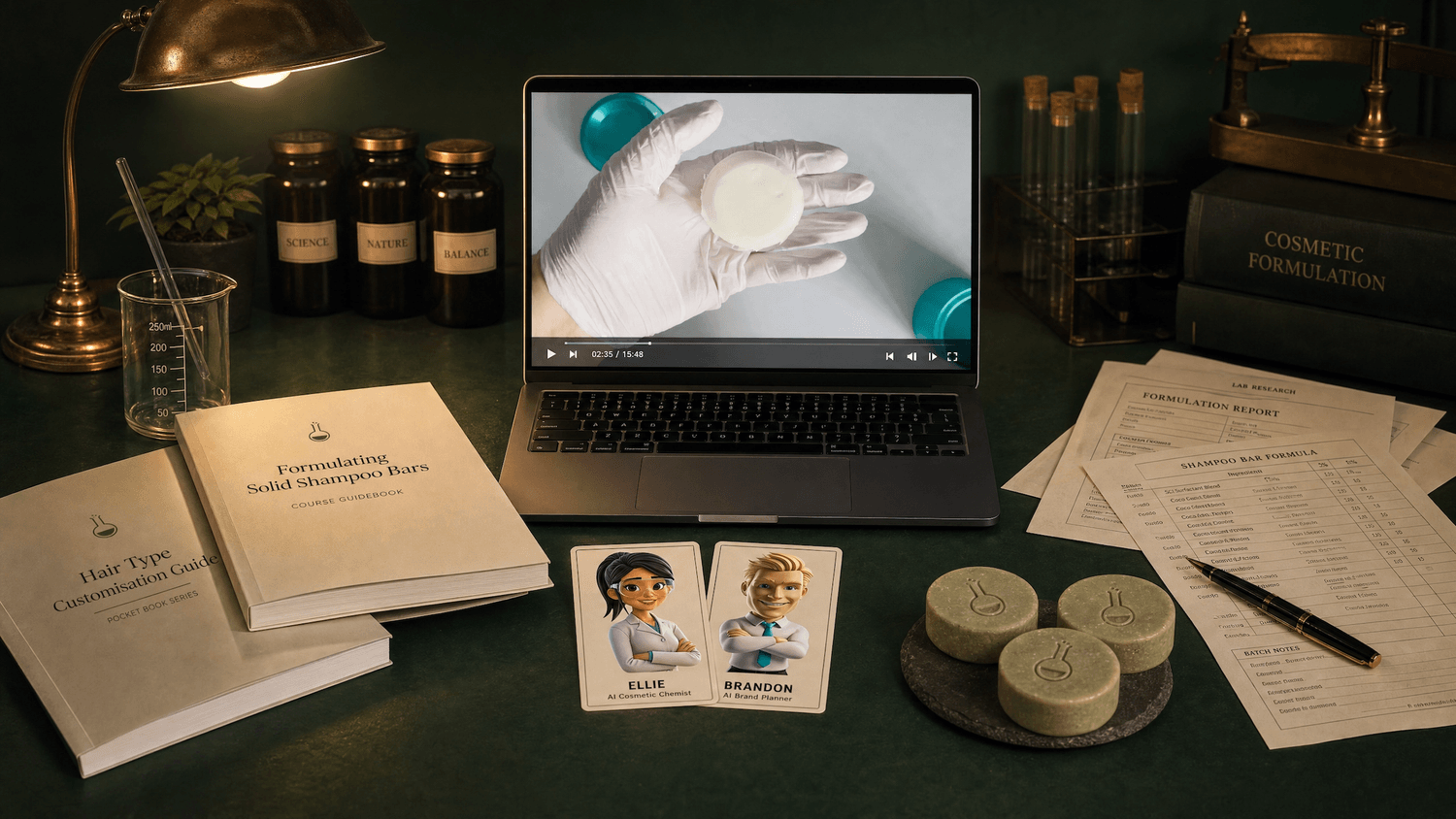
Video lessons across all 3 formulation methods
3 frame formulas to learn from and adapt
Full ingredient walkthroughs
Guidance on safe limits and formulation boundaries, so you know what to adjust, what to leave alone, and where the constraints actually matter.
Hair type customisation ebook
Ellie AI tutor trained on the course and more
Brandon, AI brand planning assistant
Lab Notes Society community access
Downloadable course guides and reference materials
60 days of access, self-paced
One payment of $197
for the full course, formulas, AI and community access, and bonuses.
HEAR FROM OUR STUDENTS
Testimonials
Highly recommended
Having learned how to make shampoo bars before, I found this course to be an excellent resource for anyone, whether you're a complete beginner or have prior knowledge. It’s well-structured, easy to follow, and breaks down the formulation process in a way that's simple to understand. The course also offers valuable insights on adjusting formulas for different hair types, making it ideal for anyone looking to create custom shampoo bars. Highly recommended!
BERNADETTE, Cohort 2024
Great experience
It was a great experience taking the shampoo bar course. The guides and formulas are very professional and easy to follow. I highly recommend this course for anyone looking to level up their shampoo bars.
JESSICA, Cohort 2025
My shampoo bars rock
You learn not one but three ways of making shampoo bars! Are you kidding me? Worth every cent. I love my hot pour balms the most, easy to upscale, easy to customise, just by sourcing different moulds. I also got Connie, the conditioner bar coach, so I now have matching conditioners, too.
TABITHA, Cohort 2025

From our formulators
MORE DETAILS
Your Questions Answered
No. The Explore module covers all the ingredient fundamentals before you start formulating. The course works for beginners as well as formulators who have made bars before and want to understand the science behind them.
A scale accurate to 0.01g, heat-safe containers or beakers, silicone moulds of your choice, a 3D-printed bar press, a heavy-bottomed milk pan to heat ingredients, and a hob or a double boiler. No professional lab needed.
Syndet stands for synthetic detergent. These bars are made with gentle, more pH-balanced surfactants rather than traditional soap. They can be formulated to a specific pH, which makes them milder on the scalp and hair.
Yes. The course teaches formulation understanding, which is valuable whether you're making bars for yourself, for friends and family, or planning to sell. Brandon (the brand planning assistant) is there if and when you're ready to think about that side.
You can focus on whichever suits your setup. The course teaches all three, so you can make an informed choice. Many students find that the method they expected to prefer wasn't the best fit once they understood the options.
Ellie is trained specifically on the course content and shampoo bar formulation. She helps you clarify terminology, revisit lesson concepts, and work through formulation logic between study sessions. She's a study support tool.
The Pro Formulator Path is a comprehensive programme covering multiple product categories. This course is a focused deep-dive on one product type: solid shampoo bars. Different scope, different purpose.
Each method is taught with its rationale before you use it. You'll learn why each one exists, what it does well, and where it has limitations. The frame formulas are there so you can see the method working in practice, but the teaching is built around understanding what's happening in the formula and why. The goal is that when you pick a method, you're picking it because you understand what it does for the bar you're making.
It doesn't eliminate it, and honestly, it shouldn't. Testing is part of formulation. But there's a difference between testing because you understand what you're looking at and changing things randomly because something didn't work and you're not sure why. This course is built so that when a batch doesn't come out the way you expected, you can work out what happened. You'll know which variable to look at, what to adjust, and what to leave alone. That's what turns a failed batch into useful data instead of wasted ingredients.
No. This is a focused skills course, not a certification programme.
60 days from enrolment. The downloadable materials, including the course guides, frame formulas, and customisation ebook, are yours to keep permanently.
You can find individual pieces of information, yes. But if you want to move beyond collecting recipes, you'll need a structured framework that ties it all together: why certain combinations work, how to troubleshoot when they don't, and how to adjust for different hair types without breaking the formula. That's what the course provides.

Hello!
I'm Timi.
A Cosmetic Chemist with 10 years of experience helping formulators hone their skills.
I first started working with solid shampoo bars while developing content for a formulation school. The more I researched, the more confused I got. Water or no water. BTMS or no BTMS. Every source gave a different answer, and most skipped the reasons entirely. But then I wasn't a cosmetic chemist; I was focusing on teaching.
So once qualified, I went back to the lab and developed three frame formulas that each solve a different problem. One is better suited for fine hair or baby hair. One works well for most hair types but needs a specific mould. One is built with upscaling in mind. They're not interchangeable, and that's the point. Each one exists because different situations call for distinct structural approaches.
The BTMS question is a good example of how I teach. It's wildly popular in the DIY community, and I don't include it in my formulas. I explain the chemistry behind that decision. But remember: you are the formulator. You review the evidence, understand the trade-offs, and make the call. That's what this course is designed to build: the ability to make your own informed decisions.
There are some genuinely great DIY shampoo bar formulas out there. The problem is that most of them come without the explanation that would help you understand why they work, or what to do when they don't. And that's what this course is here to do.
Lets Go!
Think about the next batch you make. You could go into it the same way you have before, or you could go in knowing what each ingredient does and exactly what to adjust if something isn't right.
Free Resource
Not sure what's in a product?
Decode any cosmetic ingredient list in minutes with Lexie, the Cosmetic Label Decoder.
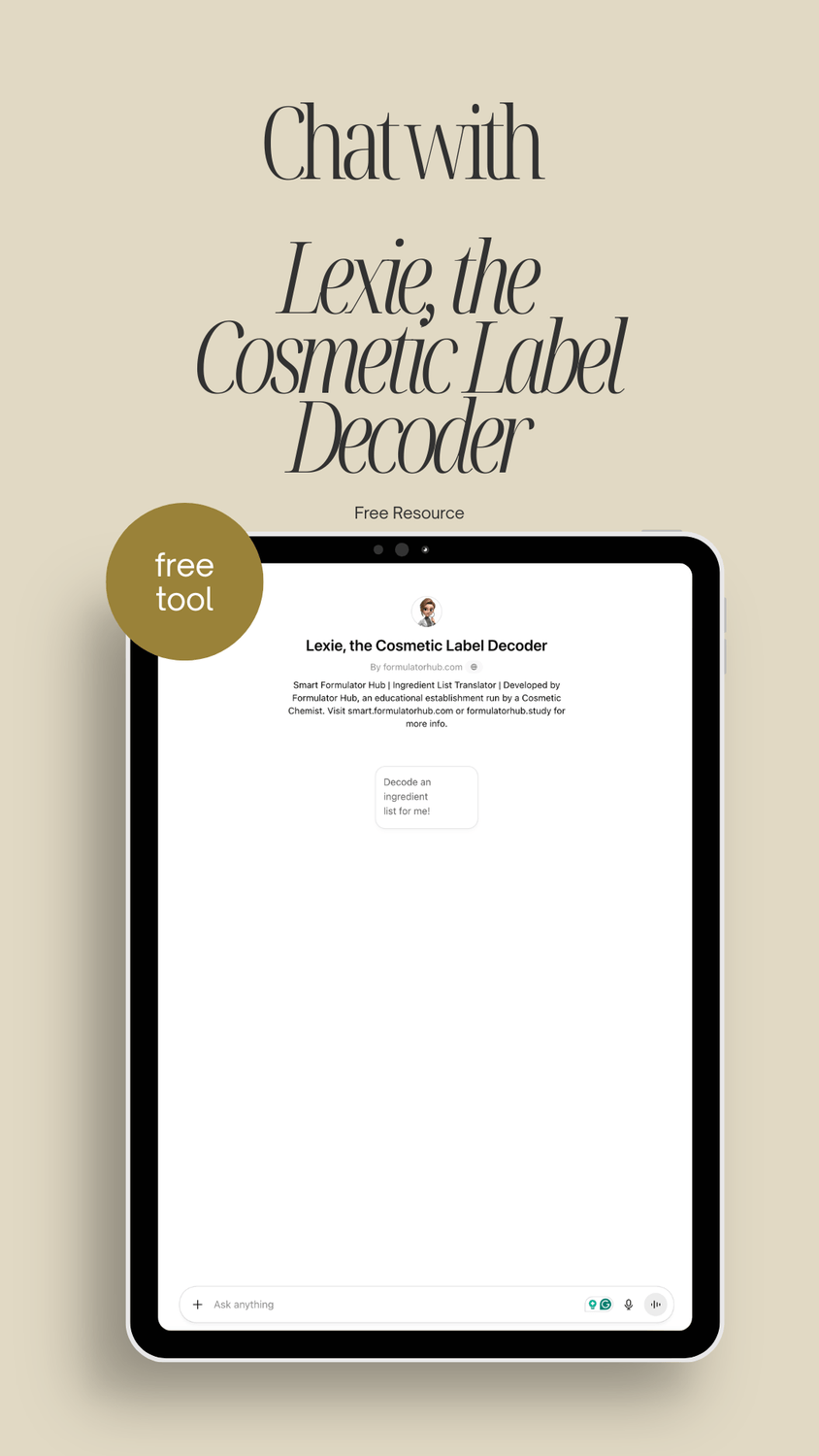
Lexie is a free AI assistant I trained to walk you through INCI lists the way a formulator would.
She'll tell you what each ingredient is, what it's doing in the formula, and how it fits with everything else on the list.
It's a good place to start if you're new to reading labels, and a useful reference if you're already formulating.
To chat with Lexie, you will need a ChatGPT account (a free account works).


About Formulator Hub
Learn to formulate cosmetics from the ground up. Understand your ingredients, build formulas that hold together, and know what to do when something doesn't behave.


Inspiration in your Inbox!
Free Signup
© 2026. All Rights Reserved