

Should formulators use AI? A practical guide to using AI in cosmetic formulation
INTRODUCTION
AI in formulation has a bit of a Marmite effect. Some people are fully bought in, some want nothing to do with it, and most are somewhere in the middle, wondering whether it's worth paying attention to.
I've been using AI tools for years, well before it became a daily topic online, and I've built several of my own as part of Formulator Hub's teaching work. That's given me a fairly clear picture of where it genuinely helps formulators and where it creates more problems than it solves.
The thing is, formulation is not just information. It's structure, context, and real-world behaviour woven together, and those are the things generic AI consistently struggles with. It can sound authoritative whilst missing the practical details that actually matter at the workbench.
HOW I THINK ABOUT AI IN FORMULATION EDUCATION
My position is quite straightforward. AI is a useful tool for some parts of formulation, and the wrong tool for others. The work is figuring out which is which, then using the right technology for the job.
Where AI genuinely helps: structured research, translation of technical language, systematic thinking, and checking your own reasoning. That's what Smart Formulator Hub is for. It's a set of AI assistants built on what I call a structured AI pathway, with solid instructions and boundaries, each trained for a specific formulation topic.
Where AI is the wrong tool: preservation decisions, troubleshooting failed batches, and anything else where getting the answer wrong has real consequences. FormuGuard and FormuFix are built on a decision pathway rather than AI. It's a logic-driven structure that walks you through the right questions in the right order, with the output determined by your answers rather than generated on the fly. There's no chatbot inside them and no risk of hallucination, because there isn't a generative model doing the answering.
That distinction matters because people assume anything smart on the internet is AI now. Sometimes the better answer is older technology applied carefully, and preservation and troubleshooting are two places where I think that's true.
Formulator Hub has been running since 2015, and I've spent those years teaching formulation whilst also working in industry R&D. Everything I build sits within an educational framework, which means the tool and the teaching work together. Whether you're using FormuGuard to work out a preservative system or Smart Formulator Hub to research an ingredient, the tool is part of the education.
WHERE GENERIC AI TENDS TO GO WRONG IN FORMULATION
Most general AI tools can only work with publicly available data, plus whatever a company has licensed or purchased to train its systems. That means the output can sound authoritative whilst missing practical context that actually matters.
In formulation, that often shows up as confident answers that are technically plausible but practically wrong, advice that ignores supplier-specific differences (even when the INCI looks similar), and substitutions that look tidy on paper but break the structure.
Here's a concrete example of what I mean. Ask a generic AI about xanthan gum, and it will confidently treat it as one ingredient with one behaviour. But in real formulation work, xanthan gum is not just xanthan gum: different grades can be clearer, softer, less stringy, or better suited to specific sensory goals. That distinction matters because choosing the wrong grade can leave you with a lotion that feels tacky, soapy, or a gel that is stringy or simply doesn’t match the finish you were aiming for.
And there's a bigger limitation: AI cannot see your beaker.
It can't feel the difference between two gels that look similar on paper but behave differently in real life. It can't observe the small changes you notice as you stir, cool, rest, and check the product again the next day.
If you've ever swapped one gum for another and ended up with a gel that strings, clumps, or turns oddly elastic, you already know what I mean. On paper, they can look interchangeable. In practice, they're not.
HOW I GOT INTO AI IN THE FIRST PLACE
My first custom GPT was Ingrid, the Ingredient Researcher, and I built her for a very practical reason. I was working with an ingredient I didn't know well, and I wanted a quicker way to pull the key information into one place: composition, CAS number, typical usage rate, and what it tends to do to skin feel.
I already had a spreadsheet for this, so I tried an AI-based approach out of curiosity, and I was genuinely surprised by how well it worked. The parts of my day that used to take a long time, checking functions, cross-referencing, pulling together notes, became quicker and calmer.
And I have to say, building tools is a bit addictive.
After Ingrid, I had an idea for Fiona, the Fragrance Composer, but I struggled to keep Fiona within sensible boundaries. Fragrance is one of those areas where it's very easy for a bot to sound helpful whilst drifting into suggestions that aren't appropriate, especially concerning allergens. I mean, Fiona used to suggest Rose oil at 2% (eek!)
Luckily, AI moves quickly, and it didn't take long for it to become easier to tighten those boundaries and keep the output under control. That's when I started sharing these assistants more widely, because I could see how useful they could be for formulators who were serious about improving their practice.
What changed my mind about using AI for everything
As I built and shared more tools, I realised there are areas where you simply can't allow a bot to give you the wrong information.
Preservation is one area, and troubleshooting is another. In those contexts, you don't just need an answer, but you need structure and guidance, the right questions asked in the right order, and the output to stay within a safe decision pathway.
A generic AI tool can give you a preservation suggestion that sounds entirely reasonable while ignoring variables that completely change what's appropriate, including water activity, pH range, whether your packaging is airtight, and whether you've included an ingredient known to interfere with your preservative system.
That's when I decided to build differently. FormuGuard and FormuFix sit on a logic engine rather than an AI model. They accept pre-programmed responses, usually in a multiple-choice format, which stops the tool from assuming or guessing what you meant, inventing variables you never gave it, or jumping to a conclusion before it has the information it actually needs. In practice, FormuGuard won't suggest a preservative system until it knows your product type, water content, pH, packaging format, and any flagged ingredients. FormuFix won't suggest a fix until it understands what happened and when it happened. The structure forces the right information to come in before any suggestions come out.
It's a different approach from asking a general chatbot and trusting the answer to cover everything you didn't think to mention.
What AI is actually useful for, if you use it well
AI can be genuinely helpful for the desk-work side of formulation: the parts where you need to organise your thinking, translate technical language, or work through a problem systematically before you go near the bench.
Translating technical language. Supplier technical data sheets can be dense, and AI is good at translating them into plain English without losing the important details. This is one of the most straightforward use cases and one where generic AI does reasonably well, because the information is mostly factual rather than context-dependent.
Organising your thinking as you design a formula. Working out which phase an ingredient belongs in, what sequence makes sense for addition, and which interactions to watch. AI can help you systematically think through these questions. It won't always get it right, but it can be a useful sounding board before you commit to a batch.
Systematic troubleshooting. One of the hardest parts of fixing a failed formula is isolating the variable. AI can help you explore the possibilities in a structured way, particularly if you provide detailed information about what happened and when. The more specific you are, the more useful the output. This is also where a structured tool like FormuFix will outperform a generic chatbot, because it's built to ask the right questions rather than accept a vague brief.
Ingredient research and function clarification. AI is useful for pulling together the basic facts about an ingredient quickly: INCI name, CAS number, typical usage rate, known functions, and common interactions. Treat it as a first pass, then verify anything important against a supplier's technical data sheet or a recognised reference source.
Reducing calculation errors. Simple formulations, percentage adjustments, batch scaling. AI handles these reliably, and it's worth using for the mechanical parts of calculation so your attention stays on the formulation decisions that actually require judgment.
What it still can't replace: testing, safety assessment, and the judgment that comes from real bench experience. I wouldn't want it to. These are not things that should be automated.
THE FORMULATOR HUB SMART TOOLS AND WHAT THEY ARE FOR
FormuGuard
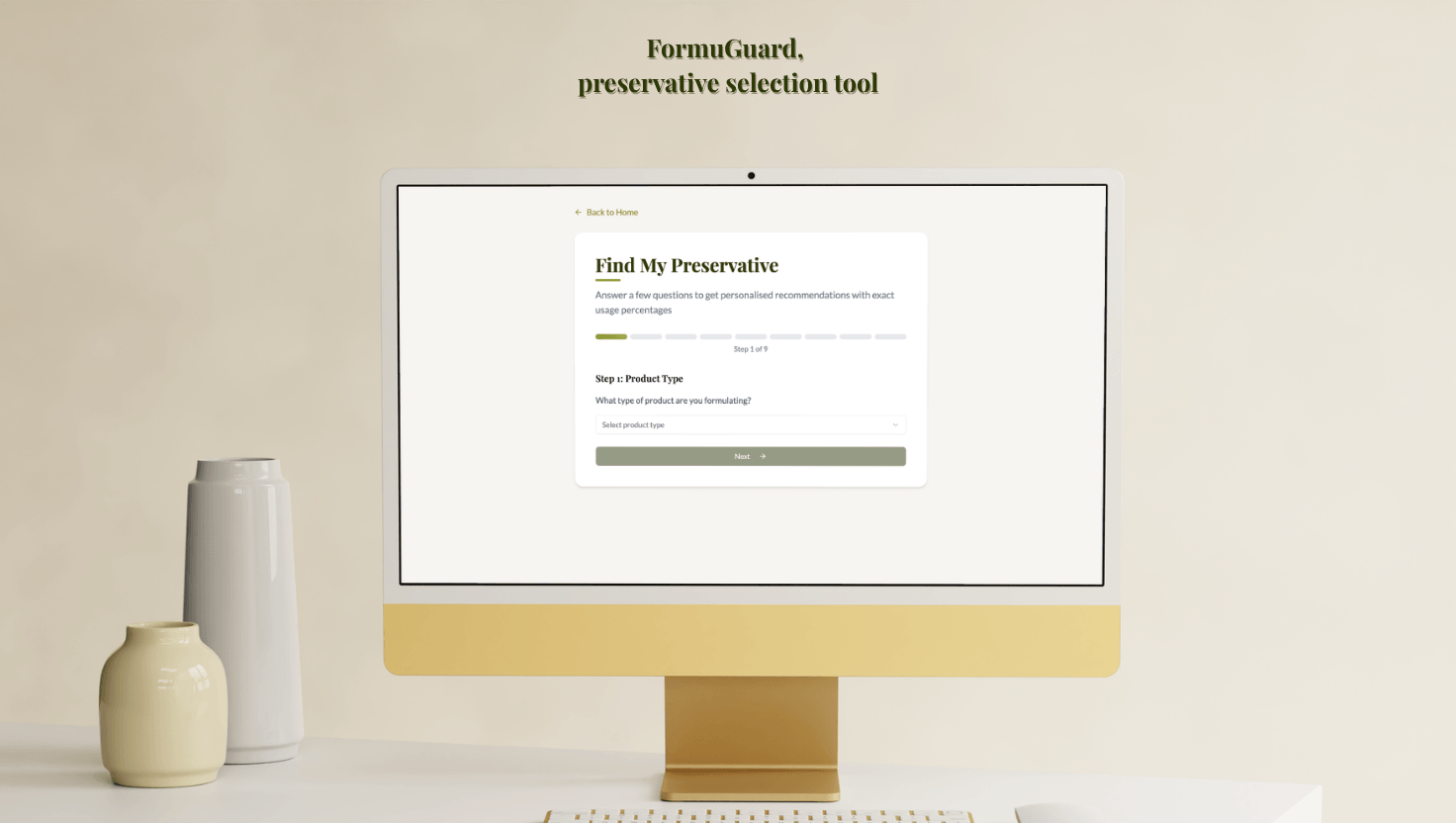
If you're choosing a preservative system and you want a structured way to narrow your options, start here.
FormuGuard asks you 9 questions, covering product type, water content, pH, packaging, any flagged ingredients, and whether you're aiming for a "natural" option. It then narrows a database of 260+ preservative options down to a smaller set that actually fits your context, and it explains why each one is being suggested.
It will also tell you why certain preservatives aren't recommended for your answers, which is often the most useful part. Knowing what to rule out matters as much as knowing what to consider.
Free 24-hour trial and then choose credits or a subscription.
FormuFix
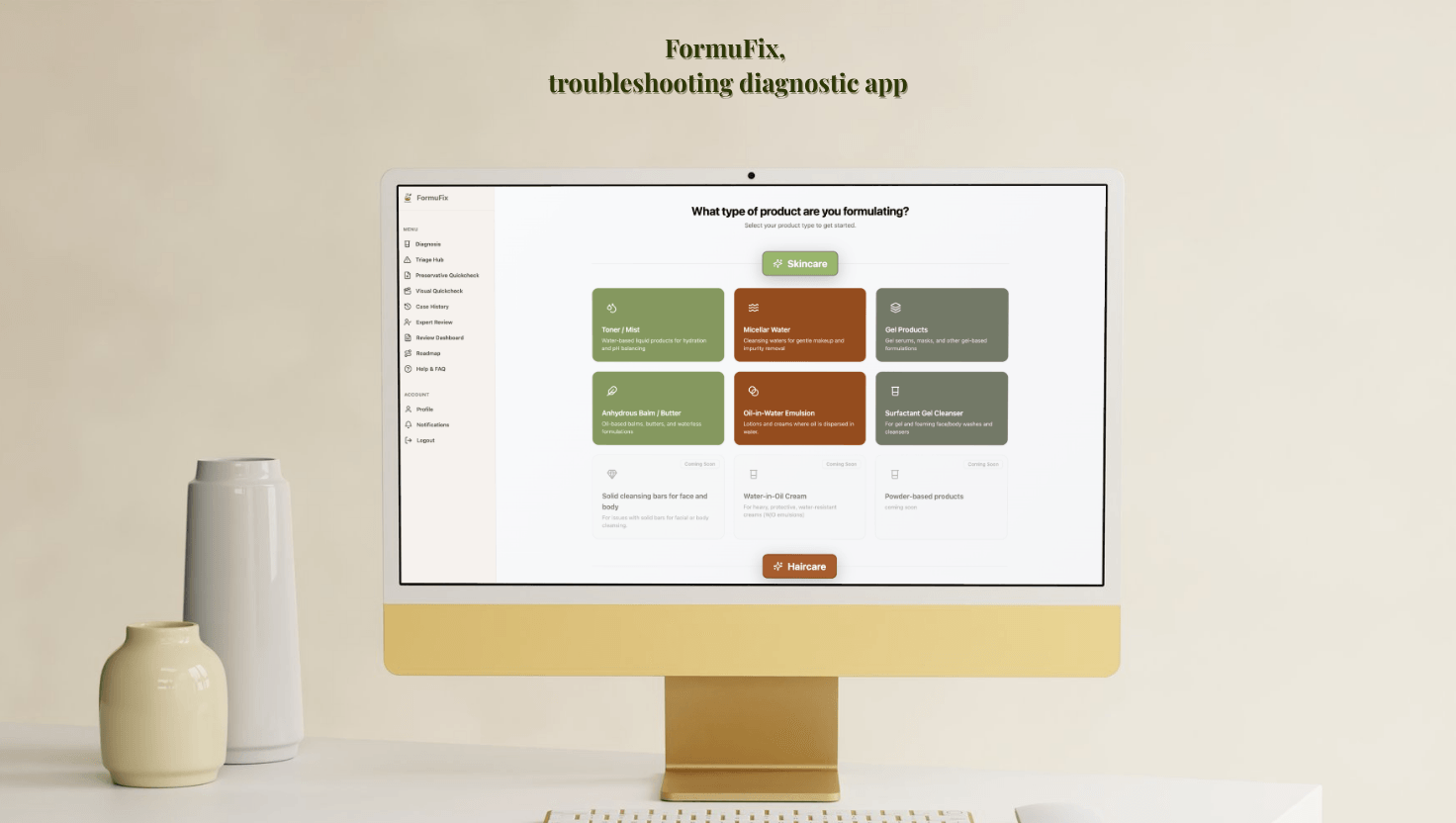
If you have a product that's separated, gone grainy, feels slimy, reacted unexpectedly, or simply doesn't feel right, this is the one.
FormuFix doesn't let you start with a vague question like "Why is my balm grainy?". It asks what happened and when, then works through the variables that actually change the outcome: your butter-to-oil ratio, how you melted the batch, how you cooled it, and how long it took for the issue to appear.
As you answer, it narrows the likely causes and suggests sensible next steps, so you're not wasting batches by swapping ingredients at random.
Smart Formulator Hub
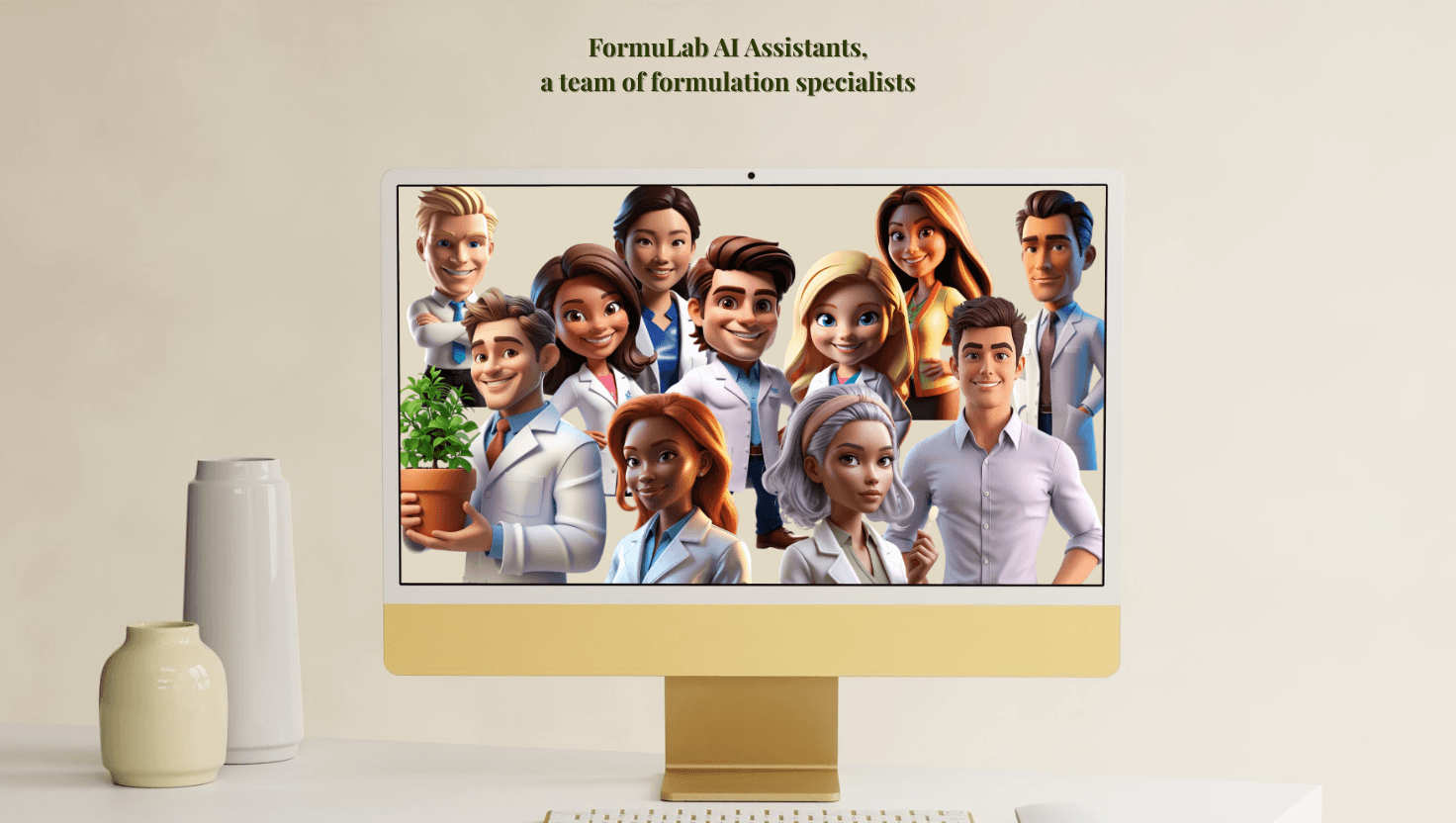
Smart Formulator Hub is a collection of eight AI assistants, each trained on a specific formulation topic and built with clear instructions and boundaries so the output stays in its lane.
You can use it for essential oil blending and safety sense-checking, ingredient research and function clarification, and herbs and herbal extract preparation with practical process guidance and more. Because each assistant is trained specifically for its topic area with my own data, the output is more focused and more reliable than you'd get from a general-purpose chatbot.
Ellie
Ellie is the AI tutor inside the courses.
She's trained on the course material she sits within, plus additional supporting content, and she's there for the questions that might otherwise stop you in your tracks mid-lesson.
You'll find Ellie inside the courses, available at any time, free to use whilst you're learning.

If you're new to using AI in formulation, start with one real task rather than trying to work out where it fits in general.
Pick a formula you're actually working on, or a problem you've genuinely had, and use the tool that matches the moment you're in:
* Choosing a preservative system: FormuGuard (https://guard.formulatorhub.com)
* Fixing a product that's not behaving: FormuFix (https://fix.formulatorhub.com)
* Researching an ingredient or learning a topic: Smart Formulator Hub
(https://smart.formulatorhub.com)
And if you're already inside a course, Ellie is there whenever you need her.
FAQ
No, and it's not trying to. AI can organise information, translate technical language, and guide you through a structured decision process. It can't test your product, observe how it behaves on skin, or make the safety and regulatory judgements that require real expertise and accountability. Think of it as something that makes the thinking work faster. It doesn't replace the thinking itself.
That depends on how the tool is built. A general chatbot can give you confident advice that's practically wrong for your situation. An AI assistant with clear instructions and boundaries, like the ones inside the Smart Formulator Hub, is safer because its output is constrained to the topic it's trained on. For higher-stakes decisions, such as preservation and troubleshooting, I took a different route. FormuGuard and FormuFix aren't AI at all. They're decision-pathway tools built on a logic engine, which means the output is determined by your answers and there's no hallucination risk.
Use it to pull together the basic facts quickly: INCI name, CAS number, typical usage rate, function, and known interactions. Then verify anything important against a supplier's technical data sheet or a recognised reference source. AI is useful for speeding up the first pass. It's not a substitute for the verification step. Ingrid in the Smart Formulator Hub can help with this.
Yes, if it asks the right questions. Generic AI often misses the variables that actually determine whether a preservative system will work: pH range, water content, water activity, any ingredients known to interact with or degrade the system and others. FormuGuard is built specifically to take those variables into account before it suggests anything. It runs on a decision pathway rather than AI, so the output is determined by your answers.
Ask it what information it would need from you to be confident in its answer. If it doesn't ask for anything specific, be cautious. A tool that gives you a detailed answer without first understanding your context is one that's making assumptions you haven't checked.
No. Smart Formulator Hub and Ellie are AI, built with solid instructions and boundaries and trained for specific formulation topics. FormuGuard and FormuFix aren't AI at all. They run on a decision pathway, which is a logic-driven structure that walks you through the right questions in the right order and delivers an output determined by your answers. That's a deliberate choice for the kinds of decisions those tools handle, where a generative model would introduce risk that isn't worth taking.
Join our free SKOOL Community for more resources!
YOU MIGHT ALSO LIKE


About Formulator Hub
Learn to formulate cosmetics from the ground up. Understand your ingredients, build formulas that hold together, and know what to do when something doesn't behave.


Inspiration in your Inbox!
Free Signup
© 2026. All Rights Reserved