

All You Need to Know About Tocopherol in Natural Cosmetics
ABOUT TOCOPHEROL AKA VITAMIN E IN NATURAL SKINCARE
Tocopherol, also often referred to as Vitamin E, is one of those ingredients you’ll see on almost every skincare label.
Tocopherol is an antioxidant loved by skincare formulators for its ability to protect both the skin and the lipids in the product itself.
But did you know there are different types of tocopherols, each with unique properties?
In this post, I’ll go through what they are, how they work, and why choosing the right one is important in formulation design.
What is Tocopherol?
Tocopherol is a fat-soluble antioxidant and a member of the Vitamin E family/group. It consists of four isomers based on their molecular structure:
1. Alpha-Tocopherol (α)
2. Beta-Tocopherol (β)
3. Gamma-Tocopherol (γ)
4. Delta-Tocopherol (δ)
These isomers have the same molecular formula but different structures, which influence how they work in cosmetic formulations. Some are better for skin care, while others focus more on stabilising oils.
Skin benefits: Antioxidant for the skin, which protects the skin from free radicals and reduces signs of ageing.
Oil stability: Antioxidant for the oil, which means preventing oils from going rancid by slowing down oxidation.
Tocopherol in Natural Lipids
Tocopherols are naturally present in lipids, especially in plant-based oils and fats. Many unrefined oils contain significant amounts of tocopherols as part of their natural composition.
Vegetable oils and carrier oils
Sunflower oil (rich in Alpha-Tocopherol)
Soybean oil (contains Gamma- and Delta-Tocopherols)
Wheat germ oil (one of the highest sources of natural Vitamin E)
Olive oil (moderate levels of tocopherols)
Argan oil, Jojoba oil, and Avocado oil (contain mixed tocopherols for added stability).
Nuts and seeds oils:
Oils derived from nuts and seeds, like Almond, Flaxseed, and Pumpkin seed oil, are naturally high in tocopherols due to their protective role in preserving the seed’s viability.
Butters:
Natural butters like Shea, Cocoa and Mango butter may contain small amounts of tocopherols depending on their processing method (cold-pressed vs. refined).
This is worth knowing because it affects how much additional tocopherol you need to add. A formula built around wheat germ oil already has a fair amount of natural antioxidant protection, while one built around refined oils with low natural tocopherol content will need more.

CHOOSING THE RIGHT TOCOPHEROL FOR YOUR PRODUCT
Let’s go through the types of tocopherols you’ll use in cosmetics, starting with my recommendation.
Mixed Tocopherols
As we mentioned, the 4 isomers bring something different to the table.
Alpha-Tocopherol: Most potent form.
Gamma-Tocopherol: Oil stabiliser, shelf-life extension of oils.
Delta-Tocopherol: Maximum oil stability.
Beta-Tocopherol: Secondary antioxidant support.
Since it’s often difficult to buy individual tocopherol isomers, suppliers extract a blend from natural oils like soybean, sunflower, and wheat germ oil. This blend is called Mixed Tocopherols and combines all four isomers. This blend of all four types gives you skin benefits from alpha-tocopherol, oil stability from gamma- and delta-tocopherols, and mild antioxidant support from beta-tocopherol. It works well in both skin-focused and oil-rich products.
Mixed Tocopherols 50%, 70% – What Do They Mean?
Mixed Tocopherols 50% and 70% refer to the concentration of active tocopherols in the product. The remaining percentage is typically made up of a carrier oil, such as soybean oil, sunflower oil, or another stabilising base.
| Label / Supplier Info | What It Means |
|---|---|
| Mixed Tocopherols 50% | 50% active tocopherols + 50% carrier oil |
| Mixed Tocopherols 70% | 70% active tocopherols + 30% carrier oil |
| Tocopherol 90–100% | Nearly pure tocopherols (very rare, high cost) |

Why are mixed tocopherols diluted?
Pure Tocopherols (100%) are extremely thick, sticky, and hard to work with. They need to be diluted to improve their pourability and ease of mixing. The carrier oil also helps stabilise the tocopherols during storage and prevents crystallisation, making them more affordable for commercial and small-scale formulations.
D and DL-Tocopherol – What Does This Mean?
It is actually very simple: if your supplier says an ingredient is D-tocopherol, it means it’s natural. On the other hand, DL refers to a synthetic version. It is the same when you purchase Panthenol: D-Panthenol vs DL-Panthenol. If you are unsure which tocopherol the supplier is offering, or if they don’t provide specifications, please contact them and ask.
D-Alpha-Tocopherol (natural)
d-Alpha-Tocopherol is the natural form of Vitamin E, extracted from plant oils like sunflower, soybean, or wheat germ oil.
It is the most bioavailable isomer, meaning the skin can absorb and use it efficiently. It works as a potent antioxidant, neutralising free radicals, which helps reduce the signs of ageing, such as fine lines and wrinkles.
While it’s best known for skin care, it also slows oil oxidation, though less effectively than Gamma- or Delta-Tocopherol.
Because it can be prone to oxidation, formulators often combine it with other antioxidants, such as Mixed Tocopherols or Rosemary CO2 Extract, to boost both skin and product stability.
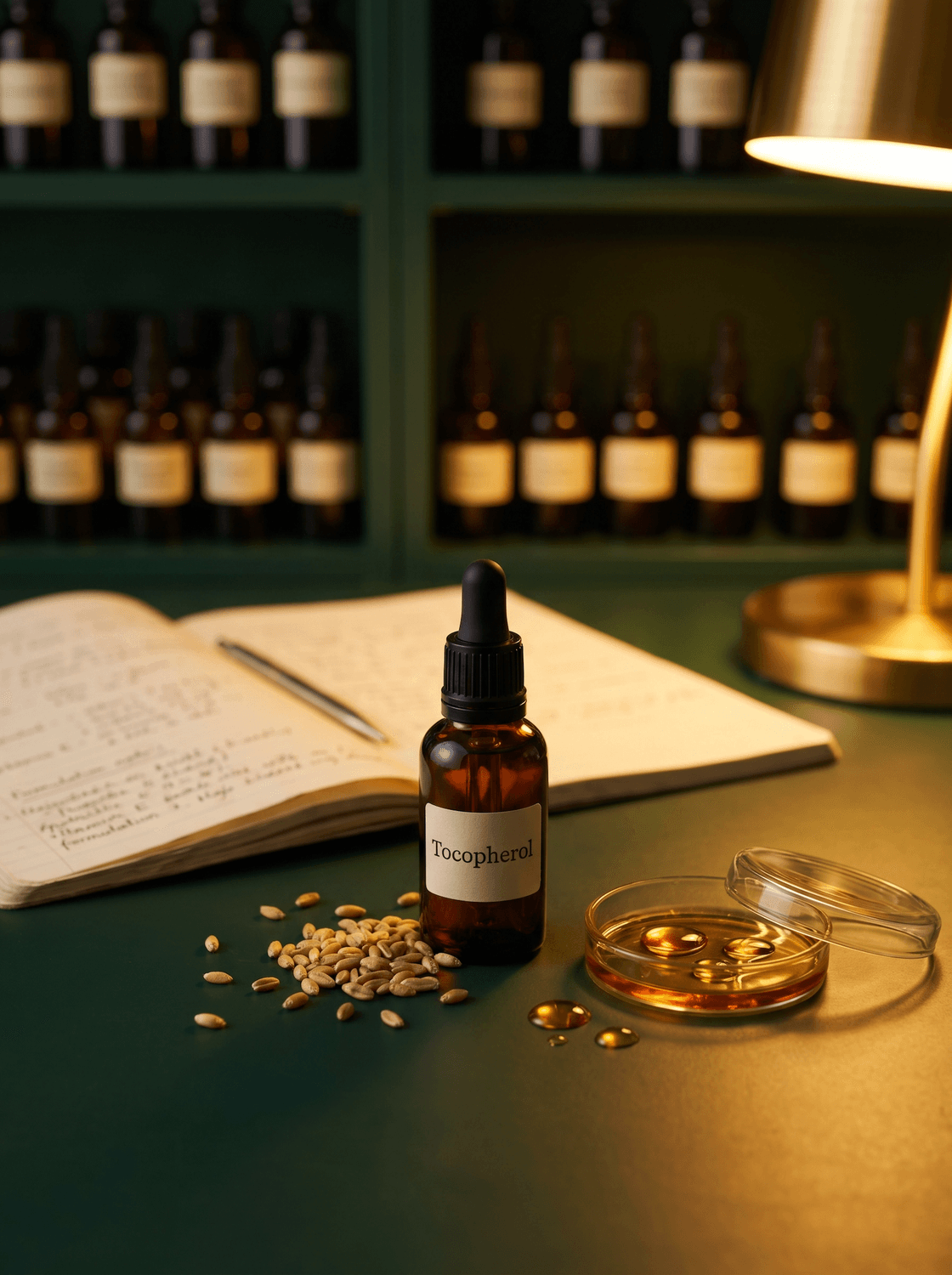
DL-(Alpha)Tocopherol (synthetic)
DL-Tocopherol is widely used because it is more resistant to oxidation, making it ideal for protecting oils in formulations, and since it’s synthetic, it’s cheaper than natural tocopherols, making it popular in mass-market products.
There’s a trade-off, though. While it works well as an antioxidant for the product, its bioavailability on the skin is lower than that of natural Vitamin E. This means that while dl-Tocopherol is fantastic for oil protection, it’s less effective at delivering skin benefits compared to natural tocopherols.
Tocopheryl Acetate: Great for the Skin
You’ve also probably noticed Tocopheryl Acetate listed in the ingredients of many skincare products. It’s a popular form of Vitamin E, but its role is often misunderstood.
Unlike tocopherol itself, tocopheryl acetate is a synthetic, modified, stabilised version of Vitamin E. It’s created by combining tocopherol with acetic acid, forming a more resilient compound that’s less likely to oxidise. However, this stability comes at a cost: it doesn’t act as an antioxidant in the product itself.
Tocopheryl acetate only becomes useful after it’s applied to the skin, where enzymes break it down, releasing active tocopherol. Once activated, it helps reduce free radical damage, improving skin health and supporting skin barrier function.
Why not use it to protect the oils in your products?
Since tocopheryl acetate is only effective after skin application, it won’t stabilise oils or extend the shelf life of your oil-based formulations. It’s excellent for anti-ageing and repair-focused products, but if you’re trying to keep oils fresh, look elsewhere.
What About Vitamin E Capsules?
Let’s talk about Vitamin E capsules. I’ve come across many DIY blogs recommending them for homemade skincare, but here’s why they’re not a good idea for cosmetic formulations, even if you are a DIY formulator:
1. Unreliable composition
Most Vitamin E capsules aren’t pure tocopherol. They’re usually diluted with oils like soybean oil or contain stabilisers, glycerols. These extra ingredients can cause product instability or interfere with your formulation.
2. Wrong type of Vitamin E
As we’ve discussed, many capsules contain Tocopheryl Acetate, which only benefits the skin, not the product itself. If you need an antioxidant to preserve oils or stop rancidity, capsules won’t work.
3. Unknown concentration
Capsules rarely provide a precise concentration of tocopherol or tocopheryl acetate. Proper formulation becomes impossible without this information, risking unstable products and unexpected skin reactions. (See FAQ on IU units.)
4. Not cost-effective
Capsules may seem affordable, but they’re inefficient for cosmetic production. Professional-grade tocopherol is more cost-effective, easier to measure, and designed for formulation use.
SUMMARY
| Type | Best For | Properties | Considerations |
|---|---|---|---|
| Mixed Tocopherols (d-) | All-in-one protection | Skin + oil antioxidant combo | Balanced, multi-purpose, good for most products |
| d-Alpha-Tocopherol (Natural - single isomer) | Skin protection + moderate oil stability | Strong skin antioxidant, moderate oil stabilisation | May need additional oil stabilisers like Gamma-Tocopherol |
| dl-Alpha-Tocopherol (Synthetic) | Oil protection | Product antioxidant only | Minimal skin benefits, cost-effective |
| Tocopheryl Acetate (Synthetic) | Skin-only antioxidant | Skin repair, free radical protection | No product/oil protection, requires enzyme activation |
Choosing the right tocopherol for your formulation comes down to knowing what job it needs to do. If you want oil protection, mixed tocopherols or dl-tocopherol are your best options. If you’re after skin benefits, d-alpha-tocopherol or tocopheryl acetate are better suited. And if you’re tempted by vitamin E capsules from the chemist, save them for your supplements.
If you’ve got questions about how tocopherol fits into a specific formula you’re working on, drop them in the comments. I’m always curious to hear what people are making and where the tricky bits are.
FAQ
No. Tocopherol is an antioxidant, not a preservative. It slows oil oxidation (prevents rancidity) but doesn’t prevent bacterial, yeast, or mould growth. If your product contains water-based ingredients, you must use a broad-spectrum preservative.
If you’re not sure which preservative suits your formula, can help you work that out based on your formula’s pH and ingredient profile.
I’d suggest using between 0.2 and 1% in formulas. This refers to the raw material, not the active tocopherol content.
Formulator tip: Using too much tocopherol can actually have the opposite, pro-oxidative effect, meaning it speeds up oxidation. It can even cause skin reactions. More is not better here.
Add tocopherol during the cool-down phase (below 40°C / 104°F) to avoid heat damage. If added too early, its antioxidant properties may break down, reducing its effectiveness.
If your formula requires a hot pour, such as lip balms, increase the amount of tocopherol to compensate for ‘lost’ amounts due to higher temperatures.
Yes and no. Tocopherol is oil-soluble and won’t dissolve in water. If you’re making a water-based product, such as a toner or gel, use a solubiliser to blend tocopherol into the formula.
I only recommend this if you are adding essential oils to your water-based product. In that case, you’ll want to protect your essential oils, so adding tocopherol with them can work.
Yes. Tocopherol works well when combined with other antioxidants. Rosemary CO2 extract is a classic choice, but Vitamin C and/or Ferulic acid with Tocopherol can create powerful antioxidant combinations for the skin.
IU (International Unit) measures biological activity in nutrition supplements, not cosmetics. In formulation, ignore IU ratings and use the % concentration listed on the supplier’s datasheet.
It refers to the raw material (the diluted version). You’d use the actual raw material at 0.2–1% in general. Please bear in mind that this is a general recommendation; there may be instances where you’d use more, such as when you pour a product while hot (like a balm, where I’d use up to 2%).
Alternatively, you can calculate the actual tocopherol content (if that is easier for you). In that case, I’d suggest 0.1–0.5% actual tocopherol in general. The more natural lipid (including essential oils) you use, the more antioxidant protection you need. There is no fixed %, it all depends on the raw material you have (50 or 70% version), the amount of lipids, and the method of formulation.
Join our free SKOOL Community for more resources!
YOU MIGHT ALSO LIKE


About Formulator Hub
Learn to formulate cosmetics from the ground up. Understand your ingredients, build formulas that hold together, and know what to do when something doesn't behave.


Inspiration in your Inbox!

Free Signup
© 2026. All Rights Reserved